Lake Pithlachocco Canoe Site, Archaeological site at Newnan's Lake near Gainesville, Florida, United States.
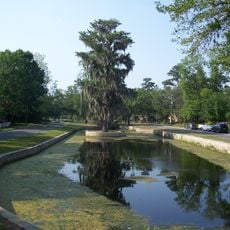
Lake Pithlachocco Canoe Site is an archaeological site on the northeast shore of Newnans Lake, east of Gainesville, Florida. It holds the remains of more than 100 dugout canoes and plank-built skiffs, exposed when a drought lowered the lake in 2000. Most canoes lay along the northeast shore; a few fragmentary ones were found on the southwest shore.
A drought in early 2000 lowered Newnans Lake and exposed over 100 dugout canoes along the northeast shore. The Florida Bureau of Archaeological Research excavated 53 canoes in June and July 2000, and two more were added after low water in May 2001. Radiocarbon dates from 41 canoes range from 5000 to 2300 BP, placing most in the Middle and early Late Archaic periods. The site was listed on the National Register of Historic Places on March 27, 2001.
The canoes show how Native American craftspeople shaped fire-hollowed logs into boats, a technique that lasted thousands of years in this region. These vessels represent skills passed down through generations of people who lived by the water and understood how to work with their environment.
The site is located east of Gainesville along State Road 26 and is accessible by car. Visitors should plan ahead since there are no parking areas, restrooms, or visitor facilities on or near the grounds.
Nineteen of the canoes, all dated between 2310 and 4160 BP, had one or more thwarts, a ridge of wood crossing the interior. Their purpose is unclear. All Archaic-period canoes were made from conifers, mostly yellow pines, though one came from a bald cypress log.
The community of curious travelers
AroundUs brings together thousands of curated places, local tips, and hidden gems, enriched daily by 94,671 contributors worldwide.