Noble Hall, Greek Revival plantation house in Auburn, Alabama, United States
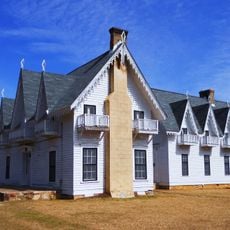
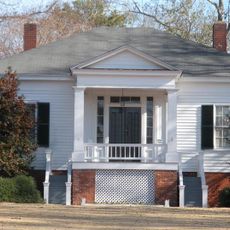
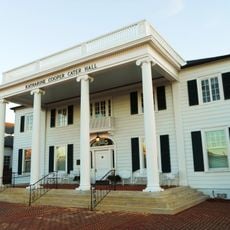
Noble Hall is a Greek Revival plantation house in Auburn, Alabama, built in 1854 of rock masonry. Its eight rooms have 12-foot (3.7 m) ceilings and 18-inch (46 cm) exterior walls. Full-width cantilevered balconies run along the front and rear, each carried by four monumental Doric columns, eight in all.
Noble Hall was built in 1854 as the main residence of a 2,000-acre cotton plantation, using rock masonry and slave labor under a contractor brought from Kentucky. It stayed with the Frazer family until cotton prices collapsed in 1922. During the Civil War it sheltered sick and injured Confederate soldiers; near the war's end, Union troops who came to ransack it took only horses and mules after a resident showed a Masonic sign.
The name Noble Hall honors Dr. Luther Noble Duncan, a president of Auburn University, whose family took over the property in 1941. The wide porches and tall columns reflect how wealthy families lived and presented themselves in the 1800s.
Noble Hall stands on its original plantation grounds outside Auburn, with the house set back from the road. The exterior kitchen, carriage house, smokehouse and overseer's house were built behind the main residence. The site was listed on the National Register of Historic Places on March 24, 1972, the first structure in Lee County to be listed.
Noble Hall was the first structure in Lee County to be placed on the National Register of Historic Places, listed on March 24, 1972. The nomination came 120 years after the house was built and 30 years after J.V. Brown began restoring it.
The community of curious travelers
AroundUs brings together thousands of curated places, local tips, and hidden gems, enriched daily by 92,609 contributors worldwide.