Norman Studios, Film production complex and African-American history museum in Arlington, Jacksonville, United States.
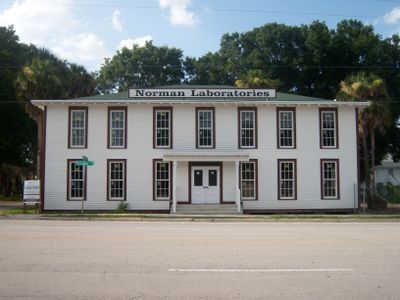
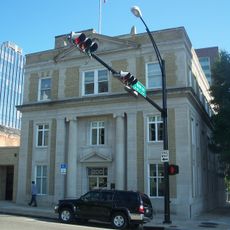
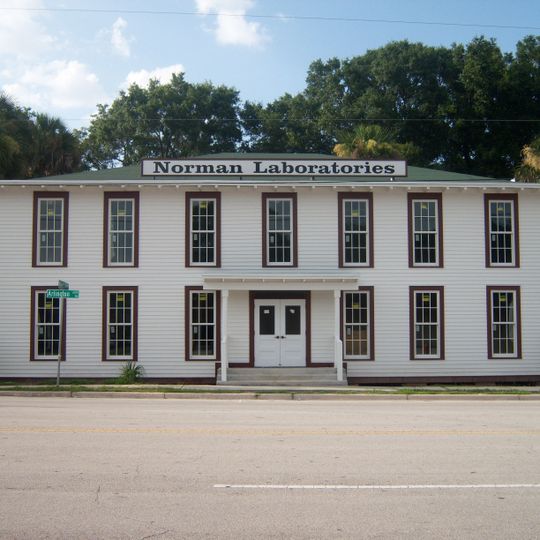
Norman Studios is a two-story building with white horizontal siding, dark red-brown trim and a dark green hipped roof, its facade holding twelve tall windows in two rows. A flat-roofed entrance with four thin white columns and double doors sits at the centre, under a sign band reading "Norman Laboratories" in gold. The site began as Eagle Film Studios in 1916 and now houses the Norman Studios Silent Film Museum.
Eagle Film Studios built the site in 1916; Richard E. Norman bought it in 1920 and produced race films with all-Black casts until 1928. After talking pictures made its equipment obsolete, the company turned to distribution and promotion before closing. The city had hosted over thirty silent studios between 1908 and 1922.
The films were "race films", a genre made for Black audiences with all-Black casts in positive roles. Richard Norman's first, The Green-Eyed Monster (1919), was re-edited into a drama and a comedy, The Love Bug, after mixed reviews. The sign band on the facade still reads "Norman Laboratories" in gold lettering.
The complex operates as a museum accessible through guided tours that must be reserved in advance to visit the preserved buildings. Allow time for your visit to explore the spaces and ask questions about how films were produced during this period.
The studio's 1926 film The Flying Ace, its best-known production, was restored by the Library of Congress and is the only Norman film known to survive. It starred J. Lawrence Criner and Kathryn Boyd, and its railroad-detective plot was later adapted from an earlier Norman story.
The community of curious travelers
AroundUs brings together thousands of curated places, local tips, and hidden gems, enriched daily by 94,559 contributors worldwide.