St. James Episcopal Church, Episcopal church in the historic district of Wilmington, North Carolina, United States.
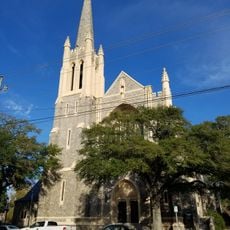
St. James Episcopal Church is a Gothic Revival church building in Wilmington's historic downtown area. The interior features detailed stone carvings and an oak altar displaying sculptured scenes from biblical narratives.
St. James Parish was chartered by the colonial Assembly on November 27, 1729, and parishioners worshipped in the New Hanover County Courthouse for over twenty years before the first church opened in 1768. New York architect Henry C. Dudley designed the truss roof of the 1839 building in 1871 and its chancel and transept in 1885. In 1865, after federal troops took Wilmington, the rector refused to pray for Abraham Lincoln and General Joseph R. Hawley had the building converted into a hospital until it was restored to church use that December.
The parish was chartered as part of the Church of England on November 27, 1729, and is one of North Carolina's oldest continually active congregations. Its name comes from Saint James, and the church remains the oldest in Wilmington. The graveyard holds the graves of Cornelius Harnett, a Revolutionary leader, and several Episcopal bishops.
The church is located at the intersection of Market and Third Streets and holds regular services and educational programs. Visitors should check opening times in advance and dress respectfully when entering.
A painting titled Ecce Homo, originally discovered in a ship captain's cabin of the Fortuna, was donated to the church in 1751. This unexpected artwork adds another layer of historical connection to the interior.
The community of curious travelers
AroundUs brings together thousands of curated places, local tips, and hidden gems, enriched daily by 92,885 contributors worldwide.