Mission San Juan Bautista, Spanish mission in San Juan Bautista, US.
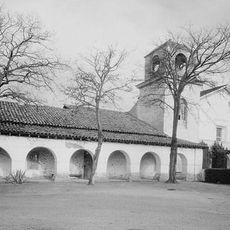
Mission San Juan Bautista is a Spanish mission station in San Juan Bautista, California, showing a large church space with three interior sections and thick adobe walls. The bell wall holds three old bells that ring again after many years, and inside are museum rooms with objects from the settlement period.
Fermín de Lasuén of the Franciscan order founded the mission on June 24, 1797, as the fifteenth of the Spanish missions in present-day California. By 1803, 1,036 Native Americans lived there, with 1,036 cattle, 4,600 sheep, 540 horses and 8 mules, and a wheat, barley and corn harvest of 2,018 fanegas. Secularized in 1835, the church was reconsecrated in 1859 and restored in 1884 and 1949.
The mission earned the nickname "Mission of Music" after Father Pedro Estévan Tápis arrived in 1815 and taught Native American boys to sing using a Spanish color-based notation; two of his handwritten choir books are kept in the museum. The three-bell campanario by the church entrance was fully restored in 2010.
Access is open daily, and all areas including the church, museum rooms, and outdoor grounds are reachable without steps. Mornings and early afternoons are usually quieter, especially on weekdays outside holiday periods.
The mission and its grounds appear in Alfred Hitchcock's 1958 film Vertigo. The tall bell tower central to the plot never existed: the church had no true tower, and Hitchcock added one with scale models, matte paintings and trick photography at the Paramount studio in Los Angeles. The tower's staircase was assembled inside the studio.
The community of curious travelers
AroundUs brings together thousands of curated places, local tips, and hidden gems, enriched daily by 94,562 contributors worldwide.