Sutter's Mill, Water-powered sawmill in Coloma, California, US.
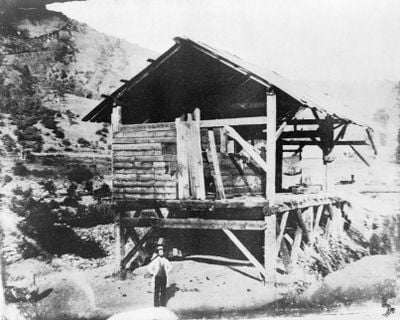
Sutter's Mill is a wooden reconstruction raised on thick log posts, with an open undercroft crossed by diagonal braces and a platform above. The left half of the upper level has a wall of stacked squared timbers; the right half is open, framed by vertical and diagonal beams under a gabled board roof. A rectangular sheet hangs in the open bay. The weathered pale wood stands on bare ground before a hillside.
James Marshall discovered gold flakes in the riverbed on January 24, 1848, while inspecting the water channel for the mill. This discovery triggered the California Gold Rush and fundamentally changed the region's population and economy within a few years.
The name honors John Sutter, a Swiss immigrant who built a colony here before gold discoveries changed everything. Visitors today see how one January day transformed the site from a quiet sawmill into a symbol of the Gold Rush.
The location sits within Marshall Gold Discovery State Historic Park and is reachable on foot from parking areas. Mornings work best when fewer visitors are around and the light shows the wooden structure well.
The meteorite that fell near the mill on April 22, 2012 was named the Sutter's Mill meteorite after the first samples were recovered here. Several dozen fragments weighing about a kilogram in total were identified, classified as a carbonaceous chondrite holding some of the oldest known material in the Solar System.
The community of curious travelers
AroundUs brings together thousands of curated places, local tips, and hidden gems, enriched daily by 94,257 contributors worldwide.