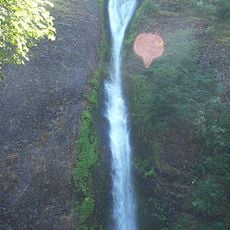
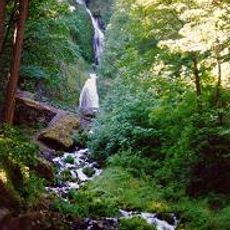
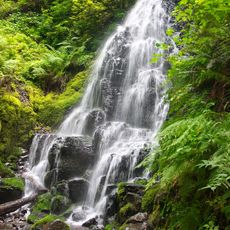
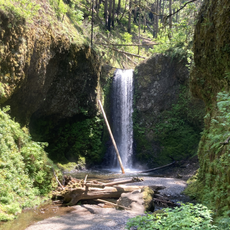
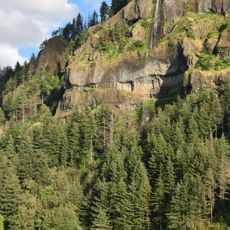
Multnomah Falls, Waterfall in Columbia River Gorge, United States.
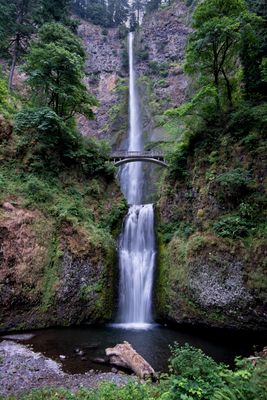
Multnomah Falls drops 620 feet (189 m) in two tiers on basalt cliffs: an upper fall of 542 feet (165 m) and a lower fall of 69 feet (21 m), with a gradual 9-foot (3 m) drop between them. The Benson Footbridge, a flat arched bridge with a horizontal railing and vertical balusters, crosses directly in front of the lower end of the upper tier. Below the bridge, the lower tier spreads into a fan-shaped cascade that reaches a pool at the base.
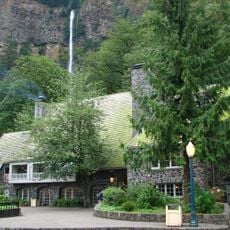
The Oregon Railway and Navigation Company ran a stop at the falls from 1884 until World War II, with a timber bowstring truss bridge at the present bridge's location that was dismantled in 1899. On Labor Day 1915, Simon Benson donated over 1,400 acres including most of the falls to the city of Portland, and Italian stonemasons built the Benson Footbridge spanning the lower falls 105 feet (32 m) above the water. Architect A. E. Doyle designed the Cascadian-style Multnomah Falls Lodge, completed in 1925.
The name recalls the Multnomah tribe who lived along this section of the Columbia River before European settlers arrived. The Benson Bridge, which spans the waterfall, honors the businessman who had it built in the early twentieth century.
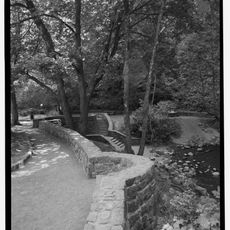
A paved path leads from the road to the viewing platform at the base, while a steeper trail climbs to the bridge and onward to the top rim. The lower platform is accessible without stairs, but higher areas require climbing steps and a longer ascent.
The falls were noted in the journals of Lewis and Clark during their 1805 expedition through the Columbia River Gorge. The Multnomah name may have been applied by S. G. Reed, a Portland mercantile clerk from Massachusetts, to popularize steamboat excursions along the river.
The community of curious travelers
AroundUs brings together thousands of curated places, local tips, and hidden gems, enriched daily by 92,075 contributors worldwide.