Elwha Dam, Historic dam site in Clallam County, Washington, US.
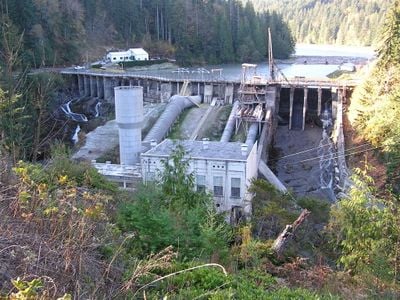
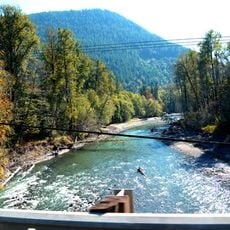
Elwha Dam was once a large hydroelectric structure that spanned across the river to supply power to nearby communities and industries. The site today shows where the dam once stood, with trails and viewpoints explaining what happened to the landscape after its removal.
The dam was built around 1910 to harness water power for the region and operated as a major energy source for many decades. Over time, people realized it was blocking the river and causing serious harm, leading to the decision to remove it completely.
The Elwha supported Chinook, coho, chum, pink and sockeye salmon plus steelhead, cutthroat and bull trout; Chinook reached 45 kg. Salmon runs once numbered over 400,000 adult returns across more than 70 miles of habitat, and tribal leaders confirmed the eroding river delta at the Strait of Juan de Fuca. After the dam went up, fewer than 4,000 adults returned to 4.9 miles.
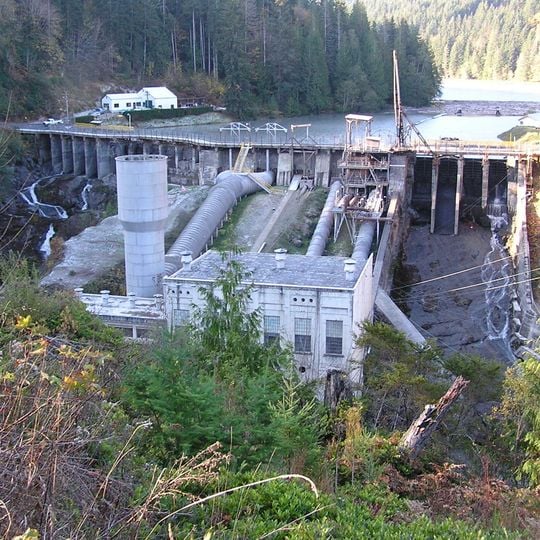
The dam stood on the Elwha River about 4.9 miles (7.9 km) upstream from its mouth on the Strait of Juan de Fuca, outside Olympic National Park, near Port Angeles. Remains of the powerhouse, five penstocks and the cylindrical surge tank can be seen at the site, listed on the National Register of Historic Places in 1988.
The Elwha River Hydroelectric Power Plant historic district, listed on the National Register of Historic Places in 1988, covered 3.5 acres and comprised the dam, the powerhouse, five penstocks and the surge tank. Demolition of the dam itself ran from September 2011 to March 2012, not 2014.
The community of curious travelers
AroundUs brings together thousands of curated places, local tips, and hidden gems, enriched daily by 93,773 contributors worldwide.