Burrard Bridge, Steel truss bridge in Vancouver, Canada
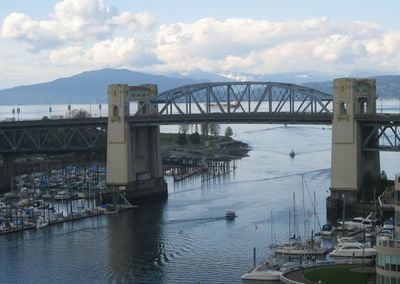
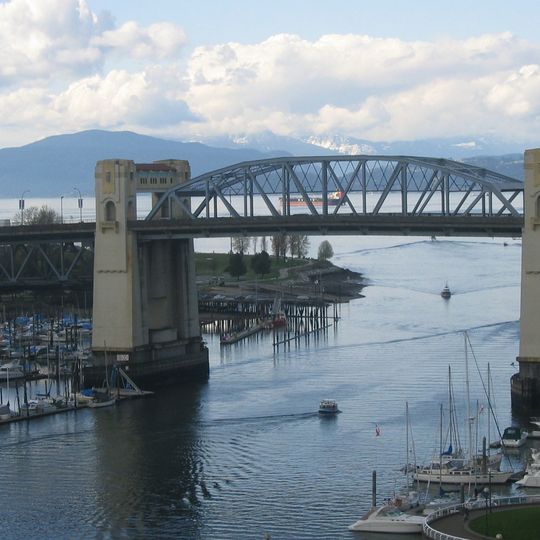
Burrard Bridge is a steel truss through arch bridge spanning False Creek to connect downtown Vancouver with the Kitsilano neighborhood. The five-part steel structure features four traffic lanes and integrated cycling infrastructure running along the crossing.
The bridge opened in 1932 and represents a key milestone in Vancouver's urban development. Its completion enabled improved connections between the growing downtown and neighboring residential areas.
The bridge's name comes from Burrard Street, which south of False Creek was called Cedar Street until 1938, when the city renamed it to match the road on the north bank. Busts of Captain George Vancouver and Sir Harry Burrard-Neale jut from the superstructure in ship prows, marked by a V and a B beneath them. The concrete railings were designed as a visual shutter: at roughly 40 to 64 km/h, motorists see through them to the harbour.
Pedestrians and cyclists use 2.6 m (8 ft 6 in) sidewalks on both sides, with dedicated cycling lanes added after the 2009 lane reallocation. The concrete railings are pierced so that, from a moving vehicle at roughly 40 to 64 km/h, the harbour stays visible through them. The central truss is screened from view by the concrete towers when you cross.
The concrete towers hide the central steel truss from drivers on the approach spans. Architect G. L. Thornton Sharp said the overhead galleries were meant to mask the steelwork and form an entrance gateway to the city; the piers also frame a sea gateway for pleasure craft.
The community of curious travelers
AroundUs brings together thousands of curated places, local tips, and hidden gems, enriched daily by 93,783 contributors worldwide.