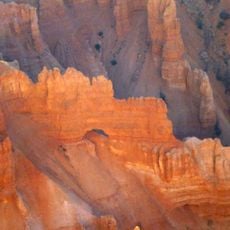
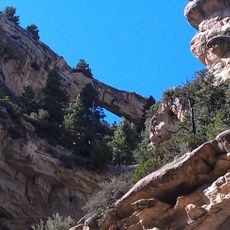
Naturita Formation, Sedimentary formation in Colorado, United States.
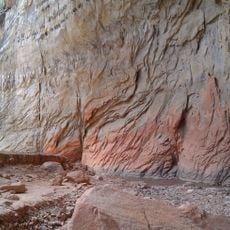
The Naturita Formation is a Cretaceous sedimentary unit in western Colorado and eastern Utah, overlying the Cedar Mountain and Burro Canyon Formations and underlying the Mancos Shale. Its lower part consists of dark-brown to black carbonaceous claystone, gray shale, and siltstone with ledge-forming gray-orange to white coarse sandstone; the middle holds thin to locally thick coal beds; the upper is gray-orange to light-brown fossiliferous sandstone interbedded with light-olive-gray shale.
The formation received its name in 1960 when geologist R.G. Young studied uranium deposits on the Colorado Plateau. This designation replaced an earlier classification as part of the Dakota Group and clarified the geological record of the region.
The formation holds fossils of early mammals, dinosaurs including ceratopsians and tyrannosaurids, plus plant remains from the Cretaceous Period.
Young named the formation for Naturita, Colorado, but did not designate a type section until five years later, in 1965. The name is not used by U.S. Geological Survey authors, though the Utah Geological Survey has increasingly adopted it. The formation is exposed across western Colorado and eastern Utah, where its coal beds and ledges of coarse sandstone can be traced.
The Naturita Formation is not the same rock as the Dakota Formation it was long confused with: Carpenter argued the two were laid down on opposite sides of the Western Interior Cretaceous Seaway, fed by different source areas, the Dakota from the North American Craton and the Naturita from the Sevier uplift along the Nevada-Utah border. Radiometric dates and fossil invertebrates show the formation getting younger southwards and westwards across Utah, recording the advancing seaway.
The community of curious travelers
AroundUs brings together thousands of curated places, local tips, and hidden gems, enriched daily by 94,408 contributors worldwide.