Kirtland Formation, Geological formation in San Juan Basin, New Mexico, United States.
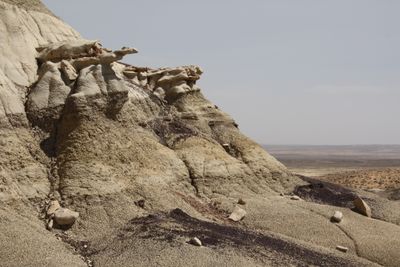
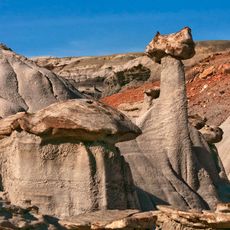
The Kirtland Formation is a Late Cretaceous sedimentary formation in the San Juan Basin of New Mexico and Colorado, laid down as alluvial muds and overbank sands from channels draining a coastal plain on the shore of the North American inland sea. It overlies the Fruitland Formation and comprises the Hunter Wash, Farmington, De-na-zin and Naashoibito members, the last now reassigned to the Ojo Alamo Formation.
The formation was named in 1916 by C.M. Bauer after the nearby Kirtland Post Office. It dates to the Late Cretaceous period, roughly 75 to 73.5 million years ago.
The formation's name comes from the Kirtland Post Office, near which C.M. Bauer described the exposures in 1916. Its fossil beds have yielded the hadrosaur Kritosaurus navajovius, the horned Pentaceratops sternbergii and the tyrannosaur Bistahieversor sealeyi, alongside the sauropod Alamosaurus sanjuanensis. The Naashoibito Member, long treated as the formation's top, is now placed back in the overlying Ojo Alamo Formation.
The Kirtland Formation is not a site with marked trails or facilities; its outcrops lie in the San Juan Basin of New Mexico and Colorado, and the Naashoibito Member has been reassigned to the overlying Ojo Alamo Formation. The named members run from the Hunter Wash at the base through Farmington and De-na-zin upward. The formation was named for exposures near the Kirtland Post Office, a useful landmark for orientation.
The Naashoibito Member, long treated as the top of the Kirtland Formation, has been reassigned to the overlying Ojo Alamo Formation, where it originally sat. Its purple mudstones differ from the four members below, and the boundary between them is gradational rather than sharp.
The community of curious travelers
AroundUs brings together thousands of curated places, local tips, and hidden gems, enriched daily by 93,654 contributors worldwide.