Aztec Ruins National Monument, Archaeological site in Aztec, New Mexico.
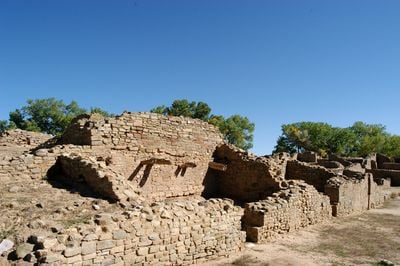
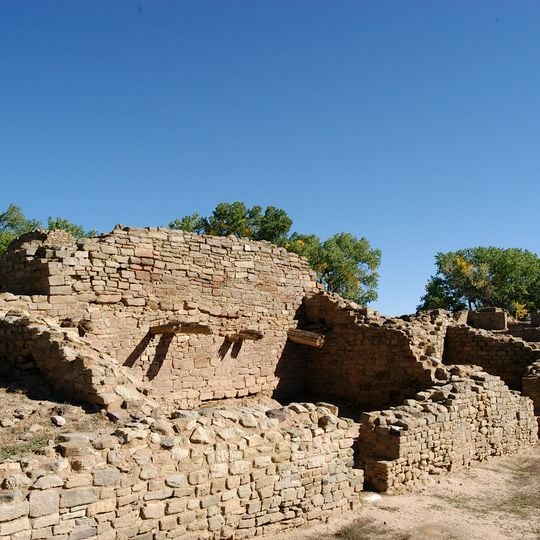
Aztec Ruins is a preserved Ancestral Puebloan settlement on the west bank of the Animas River, built mainly in the 12th and 13th centuries. Its core is a large masonry complex of small flat tan and brown stones laid in courses, with more than 400 interconnected rooms, a reconstructed Great Kiva, and a tri-wall structure at the Hubbard Site. Low ruined walls, doorways, and upright wooden posts remain visible.
Puebloan builders raised the settlement in the 12th and 13th centuries, and the main complex was finished within about 30 years. In 1923 President Warren G. Harding proclaimed it a national monument; a boundary change in 1928 made "Ruin" into "Ruins". It was listed on the National Register of Historic Places in 1966 and added to the UNESCO Chaco Culture World Heritage Site in 1987.
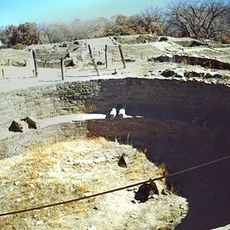
The name "Aztec Ruins" comes from 19th-century American settlers who wrongly credited the buildings to the Aztecs of central Mexico. The site's circular Great Kiva, a sunken ceremonial room, was reconstructed in the 1930s and shows how Pueblo communities gathered for rituals. Upright wooden posts still stand among the stone walls.
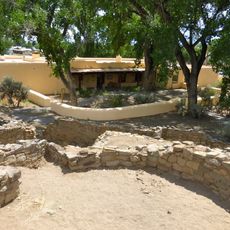
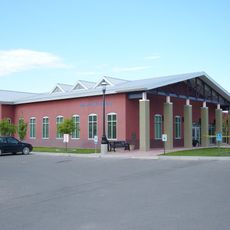
The site offers free admission and walking trails like the Aztec West Trail for self-guided exploration of the ruins. The visitor center contains exhibits with ancient artifacts and information to help you understand what you are seeing.
The site preserves original wooden ceiling beams from around 900 years ago, demonstrating how Puebloan craftspeople selected and worked with trees. These visible timbers offer visitors a direct window into the building methods and resource gathering of this ancient society.
The community of curious travelers
AroundUs brings together thousands of curated places, local tips, and hidden gems, enriched daily by 93,195 contributors worldwide.