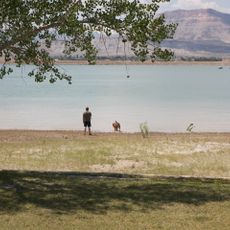
Cedar Mountain Formation, Geological formation in eastern Utah, United States
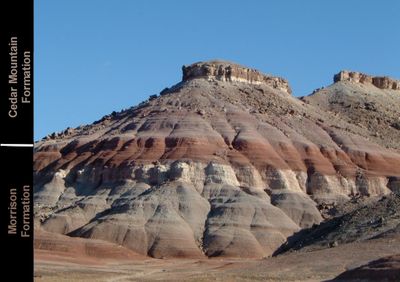
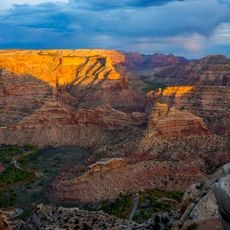
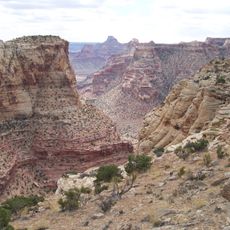
The Cedar Mountain Formation is a 125 m (410 ft) thick sedimentary unit in eastern Utah, between the Morrison Formation below and the Naturita Formation above. It consists of non-marine mudstones, sandstones and conglomerates divided into members such as the Buckhorn Conglomerate, Yellow Cat Member, Poison Strip Sandstone, Ruby Ranch Member and Mussentuchit Member.
The layer was first documented in 1944 by William Lee Stokes and named after Cedar Mountain in northern Emery County. This naming came during his systematic study of Early Cretaceous fossils in the area.
The formation's name comes from Cedar Mountain in northern Emery County, where William Lee Stokes studied the outcrops in 1944. Its members are named after places where they were first examined, such as the Yellow Cat mining area and the Poison Strip uranium district. Volunteers from the Denver Museum of Natural History found Tony's Bone Bed in the Poison Strip Sandstone in 1998.
The formations are located in protected areas and require permits for scientific visits. For casual visitors, marked viewpoints and educational trails offer insights into the geology.
The layer preserves two different dinosaur groups in its upper and lower sections, reflecting different living environments and conditions. This distribution lets researchers track how the ancient continent changed over time.
The community of curious travelers
AroundUs brings together thousands of curated places, local tips, and hidden gems, enriched daily by 94,363 contributors worldwide.