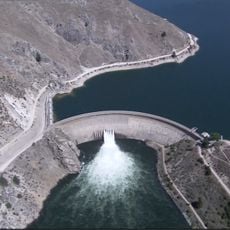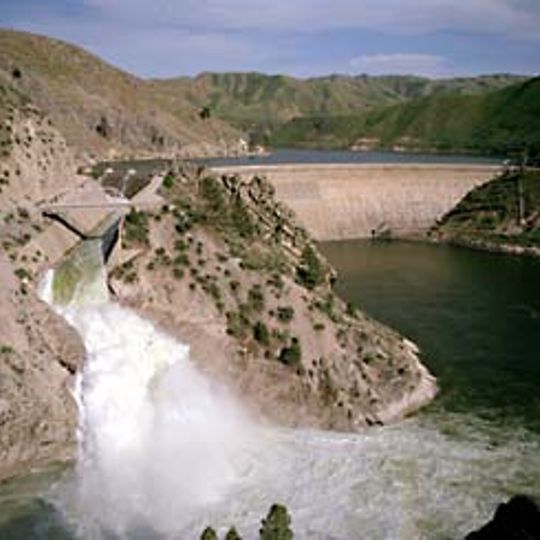
Arrowrock Dam, Arch dam in Elmore County, United States.
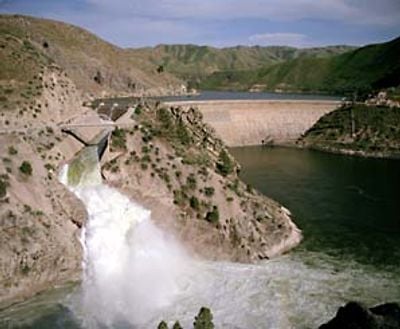
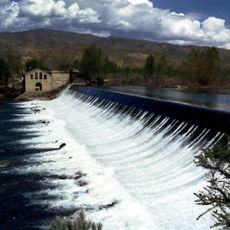
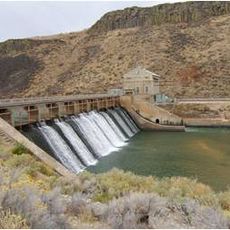
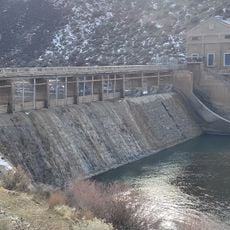
Arrowrock Dam is a concrete arch dam on the Boise River, on the border of Boise and Elmore counties in southwestern Idaho. Its pale grey-tan upstream face is thickest at the base and narrows toward the flat crest; on the left, a spillway chute releases a torrent of white water. Completed in 1915 at 348 feet (106 m), it was then the tallest concrete arch dam in the world.
Planning for a federal storage dam at Arrowrock began in 1910, on a site where Arthur De Wint Foote's private irrigation venture had earlier failed for lack of funding. Work started in early 1912 and the dam opened on 4 October 1915, at 106 metres the tallest concrete arch dam in the world until Switzerland's Schräh dam surpassed it in 1924. A railway carried visitors to the site until 1916.
The reservoir behind the dam is called Arrowrock Reservoir and stores Boise River water for irrigation. The dam's name comes from nearby Arrowrock Crossing, a landmark on the Oregon Trail. The 1915 completion drew visitors who arrived on a purpose-built railroad; the line closed in 1916 after five years because of low interest.
The dam is reached by rural roads outside Boise, and conditions on those roads can change quickly with rain or snow, so dry weather is the best time to visit. Sturdy footwear is a good idea since the ground around the viewing area is uneven.
During construction, temperature sensors were embedded directly into the concrete to track how the material cured, which was an early and forward-looking approach to monitoring a large structure. The workers' camp built on site also had running water and electric lighting, which was far from standard on remote construction sites at that time.
The community of curious travelers
AroundUs brings together thousands of curated places, local tips, and hidden gems, enriched daily by 93,783 contributors worldwide.