United States Post Office, Courthouse, and Custom House, Federal courthouse and post office in Spokane, Washington, United States
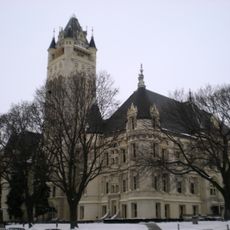
The Federal Building and U.S. Post Office in Spokane is a granite- and limestone-clad structure combining Beaux-Arts Classicism and Second Renaissance Revival. Its symmetrical facade has a granite basement, rusticated limestone first story with arched openings, and smooth upper stories with Tuscan pilasters, topped by an entablature, dentil cornice and balustraded parapet. A 1941 addition by Louis A. Simon stands directly north.
The federal government bought the site at West Riverside Avenue and Lincoln Street in 1903 for $100,000. James Knox Taylor designed the building in 1906 and 1907; construction ran from 1908 to completion in October 1909, making it the first major federal structure in the Inland Empire. A north addition by Louis A. Simon followed in 1941, and a modernization was finished in 1994.
The building's name reflects its three federal roles: post office, courthouse and custom house. Postal workers moved records from the old Post Street and Monroe Avenue office in two days in October 1909. The federal district courtroom on the third floor keeps its original stained oak rails, benches and desks.
The building occupies the block at West 904 Riverside Avenue, at the corner of Riverside Avenue and Lincoln Street in downtown Spokane. The federal district courtroom and its lobby are on the third floor, reached by elevator or the main staircase; the 1994 work installed modern elevators and high-efficiency lighting.
Above the postal workroom was an enclosed gallery called the "sneak hole", fitted with peep holes so inspectors could secretly watch employees at work. It is no longer in use. The building also housed seven cats after rats appeared in the basement four months after opening, with the postmaster paid $18 a year for each cat's care.
The community of curious travelers
AroundUs brings together thousands of curated places, local tips, and hidden gems, enriched daily by 94,354 contributors worldwide.