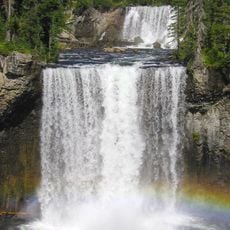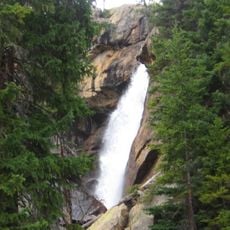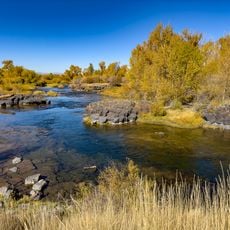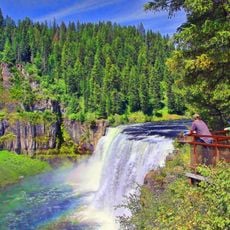
Upper Mesa Falls, Waterfall in Caribou-Targhee National Forest, Idaho, US.
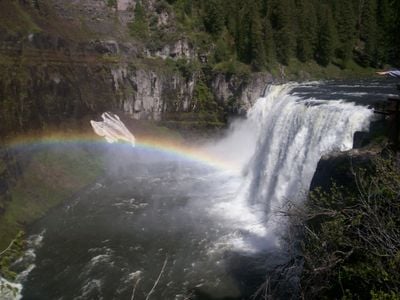
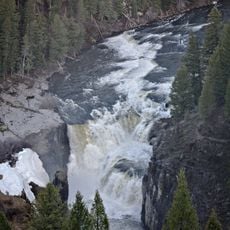
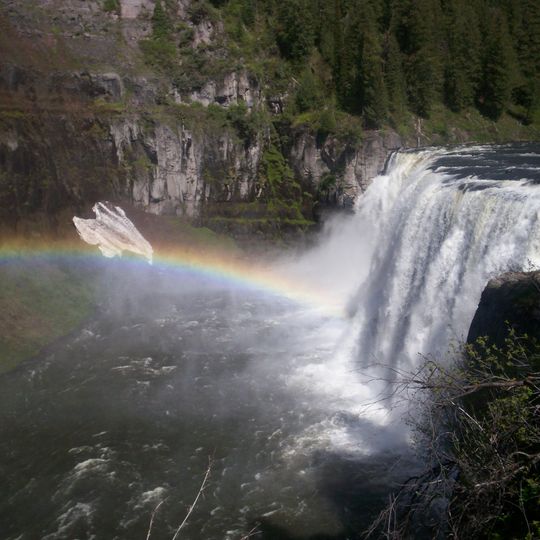
Upper Mesa Falls is a waterfall on the Henrys Fork of the Snake River in Fremont County, Idaho, dropping about 114 feet (35 m) over a face roughly 200 feet (61 m) wide. It lies in the Caribou-Targhee National Forest, about 16 miles (26 km) from Ashton, upstream of Lower Mesa Falls. The water falls as a broad white curtain into a dark basin, with a rainbow often arcing in the mist and grey rock ledges behind it.
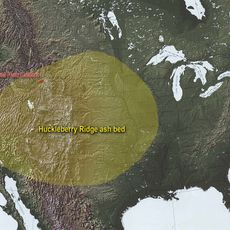
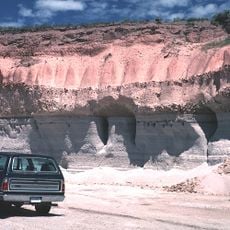
Upper Mesa Falls drops over Mesa Falls Tuff, a rhyolitic rock layer laid down about 1.3 million years ago by a cycle of eruptions from the Henrys Fork caldera; ash and rock compressed and hardened into the ledge the water crosses. Between 200,000 and 600,000 years ago the river eroded a wide canyon that basalt lava flows later partly filled, and the Henrys Fork then cut the inner channel through that basalt.
The name "Mesa Falls" refers to the flat, table-like volcanic plateau over which the river runs before it drops. Visitors who look closely at the edges of the falls can clearly see the layered rock that gives the plateau its shape.
A short loop trail with a boardwalk and observation platforms leads to the best views directly over the falls. The path is well marked from the Mesa Falls Scenic Byway and is accessible for most visitors, including those with limited mobility.
The rock beneath the falling water is Mesa Falls Tuff, an ash layer from rhyolitic eruptions of the Henrys Fork caldera about 1.3 million years ago. Later, between 200,000 and 600,000 years ago, the river cut a wide canyon that basalt lava flows partly filled; the Henrys Fork then carved the inner channel seen today.
The community of curious travelers
AroundUs brings together thousands of curated places, local tips, and hidden gems, enriched daily by 92,821 contributors worldwide.