Mammoth Site, Hot Springs, Paleontological research center in Hot Springs, United States
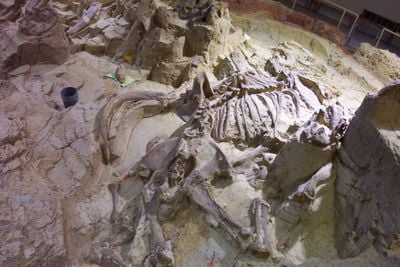
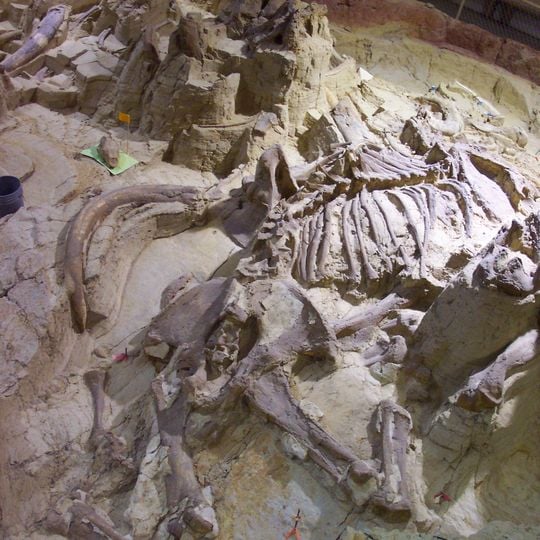
The Mammoth Site in Hot Springs encloses a Pleistocene sinkhole in the Black Hills where at least 61 mammoths—58 Columbian and 3 woolly—were trapped in a steep-sided pond formed by a collapsed cavern in Minnelusa Limestone. The sinkhole, about 65 feet deep and 120 by 150 feet wide, is now inside a building; visitors see fossils exposed in the sediment, including a long curved tusk, a massive skull and jaw, and many parallel ribs, with small orange and yellow markers near the bones.
The skeletal remains were accidentally discovered in 1974 during construction work, spurring development of a scientific research station. The site then underwent systematic excavation and became a permanent educational facility.
The site's name comes from the mammoths themselves, and its mascot is a Columbian mammoth called "Napoleon" whose skull and tusk were among the first finds. Visitors can watch excavators working the bonebed in summer and see the fossil preparation lab, where recovered bones are cleaned and stabilized.
The facility offers self-guided tours and interactive exhibits throughout the year. Visitors should allow time to explore the displays and can inquire about active excavations that are sometimes open to observation.
Researchers measuring pelvic bones found that most of the trapped mammoths were young males. A hypothesis drawn from modern elephants' matriarchal societies, where such group members are expelled, concludes they were inclined to the risk-taking that led to their entrapment.
The community of curious travelers
AroundUs brings together thousands of curated places, local tips, and hidden gems, enriched daily by 94,001 contributors worldwide.