Yukon Beringia Interpretive Centre, Ice Age research museum near Whitehorse International Airport, Canada
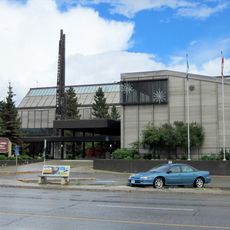
The Yukon Beringia Interpretive Centre is a research and exhibition facility at km 1423 (Mile 886) on the Alaska Highway in Whitehorse, opened in 1997. Its exhibits cover Beringia, the 3200 km landmass from the Kolyma River in Siberia to the Mackenzie River in Canada that stayed unglaciated during the Pleistocene. Displays include animal reconstructions and fossils such as giant beaver and scimitar cat.
The museum was established in 1997 as a research facility focused on the ancient Beringia landmass that connected Siberia and Canada during the Pleistocene epoch. Its founding allowed scientists to study and showcase major archaeological discoveries from sites like Bluefish Caves that reveal early human presence in the region.
The centre's name comes from Beringia, a term coined in 1937 by Swedish botanist Eric Hultén for the landmass between the Kolyma River and the Mackenzie. The Yukon Science Institute holds regular lectures here, and the Education Corner and Kids Corner run programmes for different age groups.
The museum sits along the Alaska Highway outside central Whitehorse, making it easiest to reach by car or taxi from town. Plan time to explore the interactive displays at a relaxed pace, and visiting during warmer months allows you to enjoy the surrounding area more comfortably.
The museum preserves a Yukon Horse specimen over 26,000 years old, one of the most complete large mammal remains ever found in Canadian archaeology. This exceptional specimen shows visitors how remarkably well animal bones can be preserved in frozen ground.
The community of curious travelers
AroundUs brings together thousands of curated places, local tips, and hidden gems, enriched daily by 93,671 contributors worldwide.