Salt Plains National Wildlife Refuge, National Wildlife Refuge and Natural Landmark in Alfalfa County, United States.
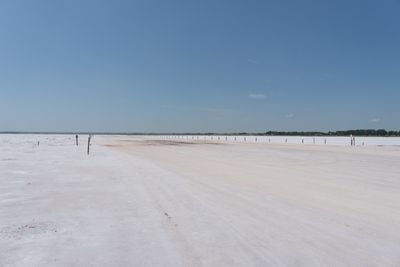
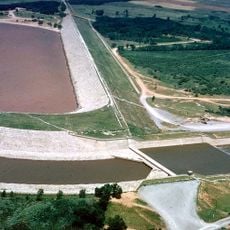
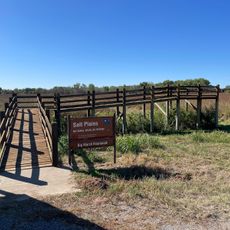
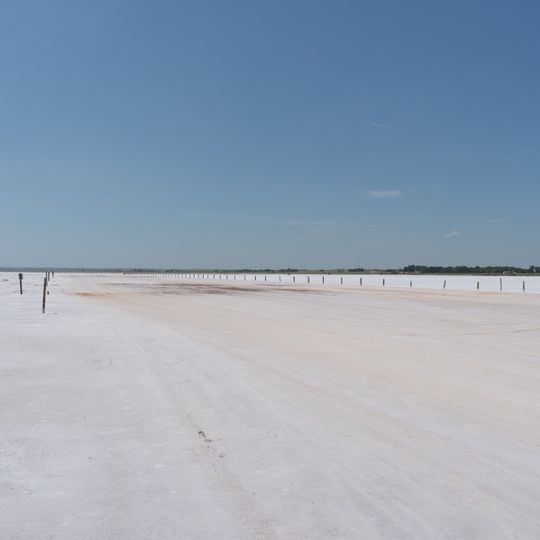
Salt Plains National Wildlife Refuge covers 32,080 acres in Alfalfa County, northern Oklahoma, north of Jet, along Great Salt Plains Lake, formed by a dam on the Salt Fork of the Arkansas River. The refuge divides into roughly equal parts bare salt flat, open water and vegetated land of marshes, woods, grasslands and croplands. A straight line of thin dark posts marks the edge of the pale, crusted flat, with a tree line beyond.
The area was protected in 1930 under President Herbert Hoover and received further designation as a National Natural Landmark in 1983. These protections secured the landscape for long-term conservation.
The Osage controlled the salt plains by 1760, using the salt to bleach deer skins and trading the surplus with other tribes. The 1835 Treaty of New Echota kept the saline area open to all tribes for salt gathering. Crystal digging is still allowed in set zones.
The refuge is open to visitors daily from sunrise to sunset with trails and observation areas for wildlife viewing. Spring and fall seasons offer the most active viewing as migratory birds pass through in large numbers.
This is one of the few places globally where visitors can dig hourglass-shaped selenite crystals from the salt flats. The crystal excavation is permitted seasonally in designated zones, drawing collectors and curious travelers from around the world.
The community of curious travelers
AroundUs brings together thousands of curated places, local tips, and hidden gems, enriched daily by 93,908 contributors worldwide.