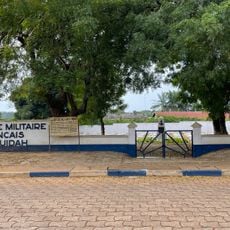
São João Baptista d’Ajudá, Portuguese Renaissance fortress in Ouidah, Benin.
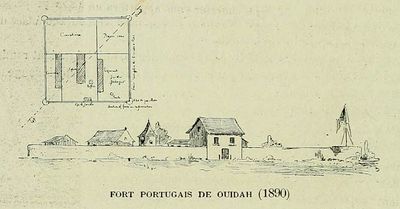
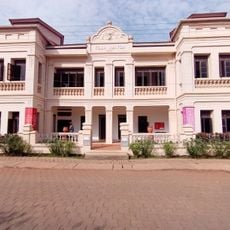
São João Baptista d'Ajudá is a small restored fort in Ouidah, about 100 metres square, built in 1721 by African labour using dried mud and local masonry methods. It has earthen bastions at each angle, each once outfitted with twelve iron cannons, and a moat twenty feet wide and deep that rarely holds water. A liftable bridge at the entrance crosses the moat. The fort now houses the Ouidah Museum of History.
Portuguese merchants built the fortress in 1721 to protect and control their trading operations along the West African coast. It remained an important post for centuries until the region changed hands and its military role ended.
The fortress embodies the lasting Portuguese presence on the West African coast, where merchants and officials anchored their language and building styles. You see this today in the architectural details and how the rooms are arranged.
The fort stands in Ouidah, a few hundred metres from the town's other former European forts, and its rooms now hold the Ouidah Museum of History, inaugurated on 6 September 1967. The building was restored in 1987 with resources from the Calouste Gulbenkian Foundation, and the work was inaugurated on 10 August 1990. Visitors enter through the courtyard, where the former powder magazine stood at the centre.
The 1958 Guinness World Records called it the smallest colony in the world, an enclave in French Dahomey occupied since 1680 and garrisoned by one officer and a few men. Portugal only recognised the annexation in 1985, and restoration work led by the Calouste Gulbenkian Foundation was inaugurated on 10 August 1990.
The community of curious travelers
AroundUs brings together thousands of curated places, local tips, and hidden gems, enriched daily by 94,553 contributors worldwide.