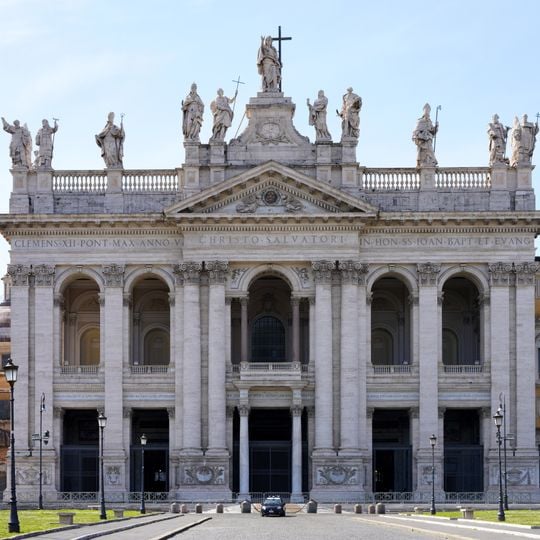
Archbasilica of St. John Lateran, Major basilica in Laterano district, Rome, Italy
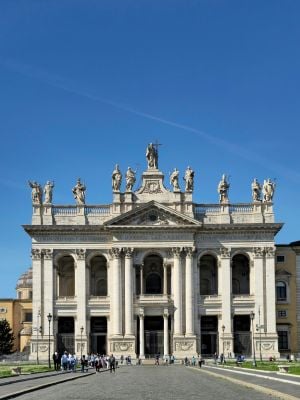
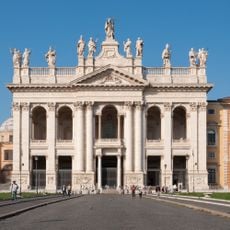
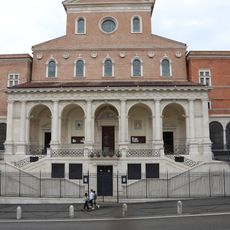
The Archbasilica of St. John Lateran is the cathedral of Rome, on the Celio hill in the Laterano district. Its pale stone facade, completed in 1735 under Clement XII, has five tall arches, paired columns and a triangular pediment, with statues on the roofline and a cross at the top. The Latin inscription reads Clemens XII Pont Max Anno V Christo Salvatori In Hon SS Ioan Bapt et Evang.
Constantine gave the Lateran palace and lands to Bishop Miltiades after his 312 victory at the Milvian Bridge; the site had held the Castra Nova of the imperial horse guard, demolished after the battle. Pope Sylvester I dedicated the church in 324. Two fires struck in the 14th century, and Sixtus V rebuilt it in the late 16th century; the facade was completed in 1735 under Clement XII.
The title Omnium Urbis et Orbis Ecclesiarum Mater et Caput, Mother and Head of All Churches of the City and the World, is an honorary title of this archbasilica, the only one in the world. Its titular feast is 6 August, the Transfiguration of Christ, because Christ the Saviour is its primary dedication. The President of the French Republic is ex officio its First and Only Honorary Canon, a title held by French heads of state since King Henry IV.
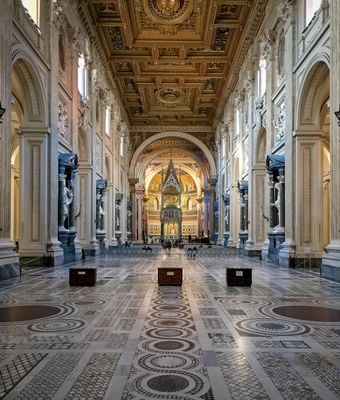
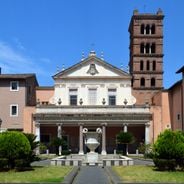
The church opens daily from 7 AM to 6:30 PM and allows visitors to see the main nave as well as the adjacent medieval cloister. A visit in the early morning helps avoid larger groups and lets you examine the architecture calmly.
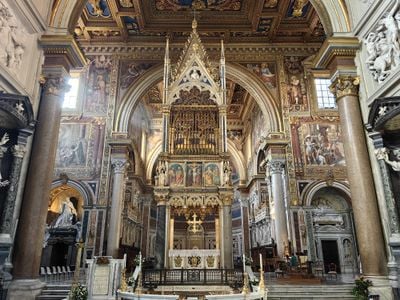
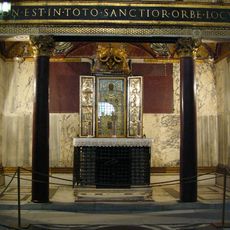
Beneath the altar lie the heads of the apostles Peter and Paul in silver reliquaries, visible only through a grille from below. The adjacent 13th-century cloister shows twisted columns with inlaid mosaic patterns, created by artists from the Roman marble-working Cosmati family.
The community of curious travelers
AroundUs brings together thousands of curated places, local tips, and hidden gems, enriched daily by 92,263 contributors worldwide.