St. Peter's Baldachin, Bronze canopy in St. Peter's Basilica, Vatican City
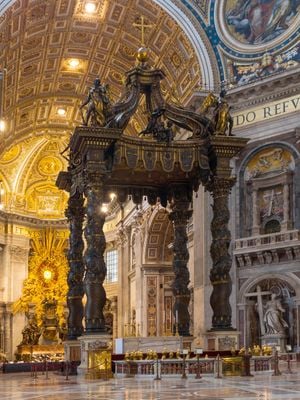
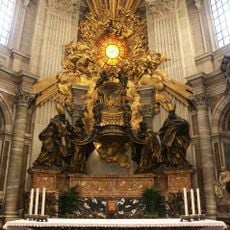
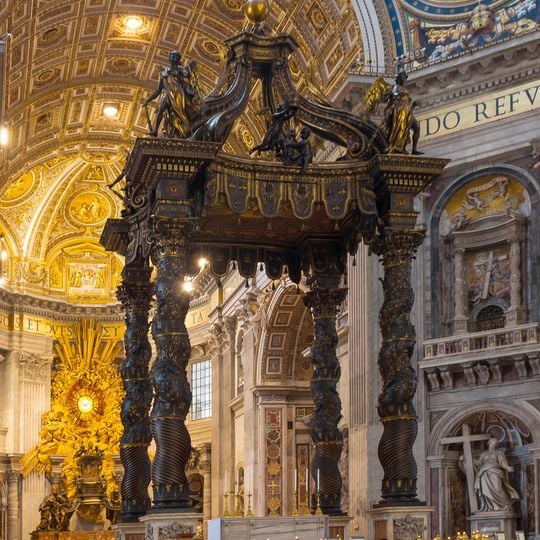
St. Peter's Baldachin is a bronze and gilded ciborium over the high altar of St. Peter's Basilica in Vatican City, standing at the centre of the crossing beneath the dome. Four helical columns, each 20 metres high and cast in three sections, rise from marble plinths decorated with the Barberini coat of arms. They carry a concave cornice with a scalloped, tasselled bronze valance; on the corners stand four twice-life-size angels, and above them volutes support a gilded cross on a sphere. The underside of the canopy shows a radiant sun with a dove.
Gian Lorenzo Bernini created the baldachin between 1623 and 1634 at the request of Pope Urban VIII. The work took eleven years and was meant to mark the tomb of Peter directly beneath the high altar.
The bees scattered across the bronze columns represent the Barberini coat of arms and recall who commissioned the work. Gilded angels stand watch at each corner, giving the structure a ceremonial presence that pilgrims notice immediately.
You can view the structure from several spots in the basilica, with the best angle coming from the central nave. The columns appear different depending on where you stand, as light from the dome windows shifts the visible detail.
Urban VIII's own diary records that the Pantheon bronze was taken for cannons at Castel Sant'Angelo, while the baldachin's bronze came from Venice. The satirical pasquinade "Quod non fecerunt barbari, fecerunt Barberini" was attributed by art critic Sandro Barbagallo to Monsignor Carlo Castelli, the Duke of Mantua's ambassador.
The community of curious travelers
AroundUs brings together thousands of curated places, local tips, and hidden gems, enriched daily by 92,652 contributors worldwide.