The Vision of Constantine, Equestrian sculpture at Scala Regia, St. Peter's Basilica, Vatican City
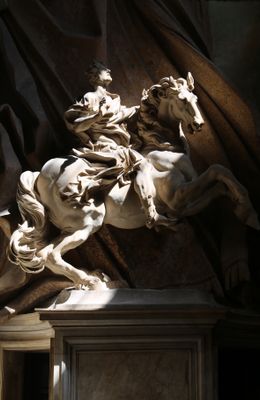
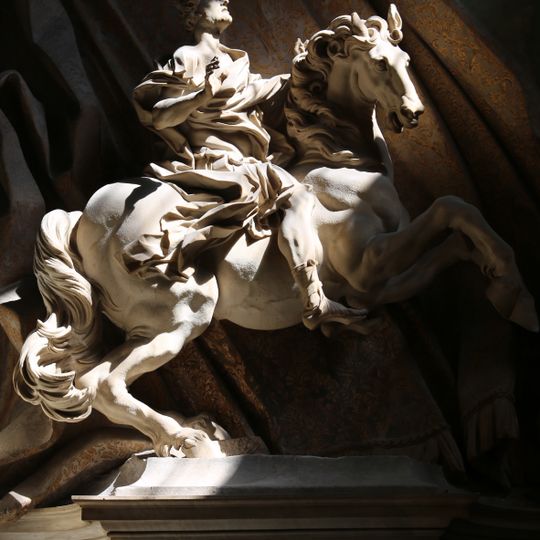
The Vision of Constantine is a white marble equestrian sculpture by Gian Lorenzo Bernini, set in the niche at the foot of the Scala Regia in Vatican City. Constantine sits upright on a rearing horse, his right arm raised toward his chest, wearing a draped garment and sandals. The horse lifts its front legs and turns its head right, with a thick mane and tail. The group rests on a rectangular base with stepped molding.
Bernini began the work in 1654, probably commissioned by Pope Innocent X, but only started carving the marble block in 1662. In the 1660s the statue was reassigned to the Scala Regia, which Bernini was then rebuilding, and it was finished in 1668. It reached its niche on 12 January 1669 after a ten-day move, and the setting was unveiled in 1670.
The scene depicts the moment before the Battle of the Milvian Bridge, when a cross appeared above the sun with the words "In Hoc Signo Vinces" (By this sign, you will conquer). Constantine's raised arm responds to that sign; the cross itself is hard to make out from below, a point raised by pamphlets published right after the 1670 unveiling.
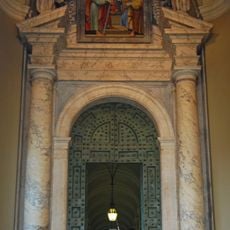
The sculpture stands in the niche at the foot of the Scala Regia, the stairway linking St. Peter's Basilica with the Vatican Palace. Without special access to the Vatican, it can only be seen from one viewpoint, beneath the portico of St. Peter's. Plan for that single angle rather than a walk-around view.
The cross that inspired Constantine is not part of the sculpture and was invisible to many early viewers, which critics noted in pamphlets right after the unveiling. Bernini also left out saddle and reins, and gave the horse an exaggerated length, long neck and immense tail to increase the sense of movement.
The community of curious travelers
AroundUs brings together thousands of curated places, local tips, and hidden gems, enriched daily by 92,917 contributors worldwide.