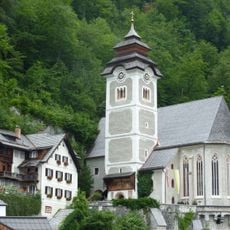
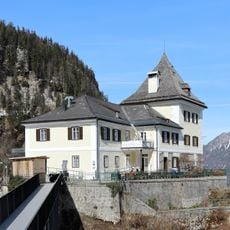
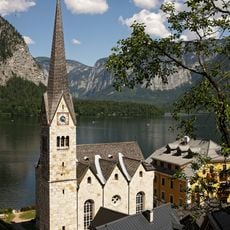
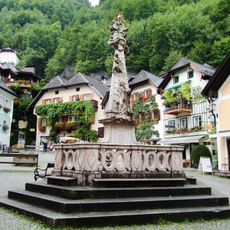
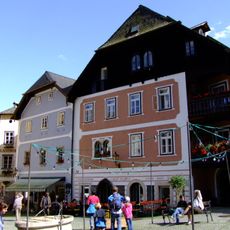
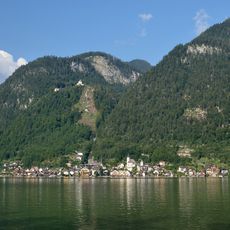
Hallstätter See, Alpine lake in Salzkammergut region, Austria.
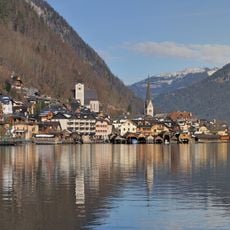
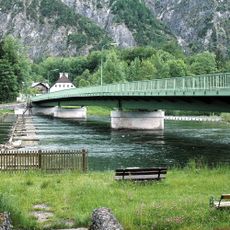
Hallstätter See is a 7.5 km long, fjord-like lake in Upper Austria's Salzkammergut, lying at 508 m below the Dachstein massif. It is 1.4 km wide at most, covers 8.55 km² and reaches 125 m in depth. Hallstatt occupies the western shore, Obertraun the southeast, and Bad Goisern's hamlets the northern outflow. Steep, partly wooded slopes fall directly to the water.
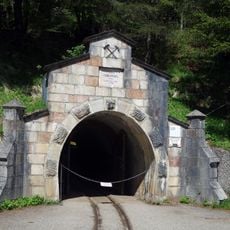
The lake lies at the foot of the Dachstein massif in the Salzkammergut. Hallstatt's salt mining, active since prehistoric times, made the town a starting point of the world's oldest still-working industrial pipeline, which has carried brine to Bad Ischl since 1596 and on to Ebensee. The lake forms part of the UNESCO World Heritage cultural landscape Hallstatt–Dachstein/Salzkammergut.
The lake is named after Hallstatt, the market town on its west shore whose salt mining dates to prehistoric times. Until around 1980 the crossing to Hallstatt's railway station on the east shore was Austria's only mail-carrying ship line; when the ice was thick enough, mail and passengers were moved by sled, later by a motorized track vehicle.
The lake has swimming areas near each settlement, with public beaches and facilities available during the warmer months. Walking paths ring much of the shoreline, making it easy to explore the lake from different viewpoints and villages.
The ferry linking Hallstatt town with its railway station on the east shore was Austria's only ship-borne mail line until around 1980. When the ice was thick enough, mail and passengers crossed by motor sled instead of boat. A tunneled road later took over the mail, which now travels by bus and truck.
The community of curious travelers
AroundUs brings together thousands of curated places, local tips, and hidden gems, enriched daily by 92,630 contributors worldwide.