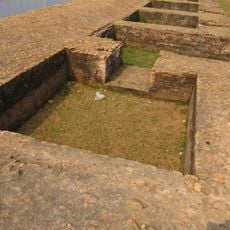
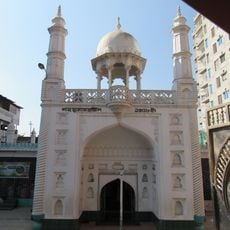
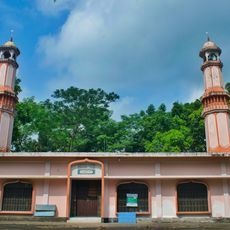
Bazra Shahi Jam-e-Masjid, Mughal mosque in Begumganj Upazila, Bangladesh.
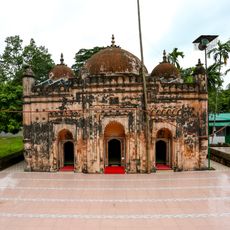
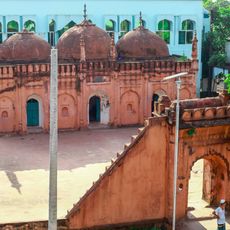
Bazra Shahi Jam-e-Masjid is a brick mosque in Begumganj Upazila, Bangladesh, with a rectangular plan, three rounded domes on the roof, and octagonal towers at each of its four corners. Three arched gateways open along the eastern facade and serve as the main entrances.
Construction began in 1741 under Mughal emperor Muhammad Shah, commissioned by Aman Allah, whose name appears in an inscription above the central doorway. In the early 20th century, the zamindars of Bazra restored the building and added ceramic mosaics to its surfaces.
The mosque is known locally as Bojra Shahi Mosjid and lies in Bazra village, Sonaimuri Upazila, about 20 km north of Noakhali. Its interior is divided into three bays by two multi-cusped arches, with three mihrabs on the qibla wall, the central one larger than the other two. The Department of Archaeology has listed it as a protected site since 29 November 1998.
The mosque stands on high ground on the western side of a dighi, 20 kilometres north of Noakhali at Bazra village. An outer wall encloses the site, with the ornate gateway set in the east wall. The Department of Archaeology has protected the building since 29 November 1998.
The ceramic mosaics covering parts of the outer walls were added long after the original structure was finished, so the building carries two clearly separate layers of craftsmanship. The mosaic fragments are not uniform but vary in pattern from panel to panel across the surface.
The community of curious travelers
AroundUs brings together thousands of curated places, local tips, and hidden gems, enriched daily by 93,378 contributors worldwide.