Pont de Fragnée, Liège, Steel bridge in Liège, Belgium
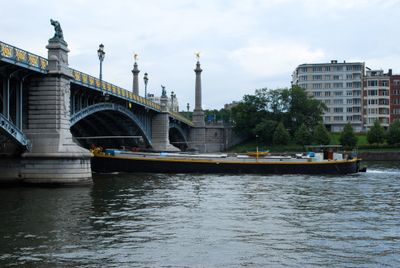
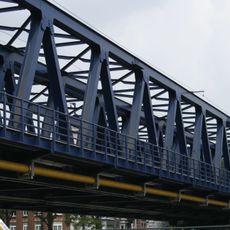
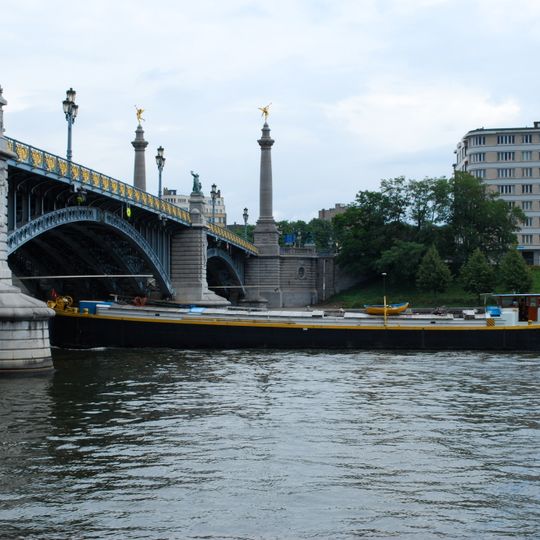
The Pont de Fragnée is a 177.6-metre steel bridge over the Meuse in Liège, with three metal arch spans on stone piers. A blue steel arch with a lattice of vertical and diagonal members rises beneath the deck, edged by a yellow-gold ornamental band. Two tall stone columns topped with gilded figures stand at the piers, and two black lampposts with glass lanterns stand on the deck.
Built from 1901 to 1904 for the 1905 World Fair in Liège, the bridge was modelled on the Pont Alexandre-III in Paris. In 1940 the Belgian army blew it up to slow the German invasion; its four bronzes fell into the Meuse and were later recovered. Rebuilt to the original plans and reopened on 4 November 1948, it was widened from 16 to 17.20 metres. A full renovation from 1993 to 2000 dismantled and restored its 37,000 elements.
The bridge is nicknamed "pont des anges" after the four gilded Renommées, angel-like figures crowning the granite pylons at each entrance. The bronze allegories of the Old River and the New River, with a man and a woman lifting a shell, were made by Victor Rousseau to Paul Demany's design; the railings and three-branched lamps are by Julien Dillens.
The bridge is open to pedestrians and vehicles with illuminated pathways and bronze street lamps for safe passage at any time. Access is straightforward from both sides of the Meuse with clear walking areas separated from traffic.
The four gilded bronzes crowning the granite pylons are Renommées, or angels, which gave the bridge its nickname "pont des anges". They were gilded during the 1994 renovation, as were the mythological medallions of the railings.
The community of curious travelers
AroundUs brings together thousands of curated places, local tips, and hidden gems, enriched daily by 93,911 contributors worldwide.