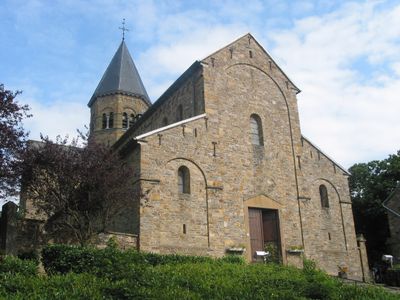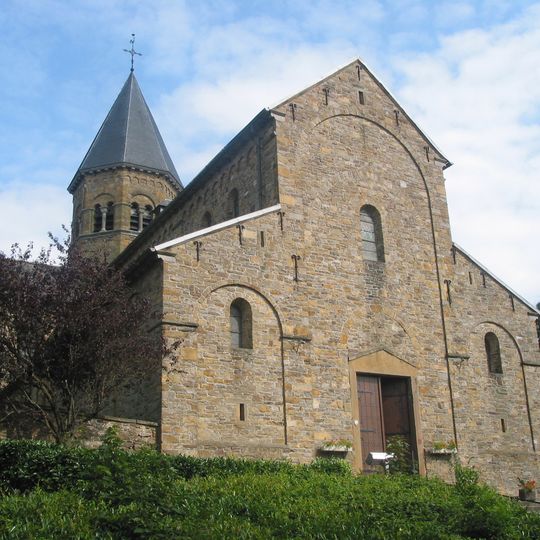
Église Saints-Pierre-et-Paul de Saint-Séverin-en-Condroz, Romanesque church in Saint-Séverin-en-Condroz, Belgium.
The Église Saints-Pierre-et-Paul is a Romanesque building with yellow sandstone walls arranged in a Latin cross layout, complete with two side aisles and a transept that matches the main nave's width. Its interior displays the structural clarity typical of the period, with distinct zones for worship and processions.
Built in the 12th century, this church served a priory dependent on Cluny Abbey and is the only surviving witness of Cluniac architecture in Belgium. It later became the village parish church and is listed as major Walloon heritage.
The church is the only surviving example of Cluniac architecture in Belgium, a synthesis of Burgundian and Romanesque forms that writers call typically Walloon or Mosan. The stone is local psammite of the Condroz, quarried as "pierre d'avoine" for its oat-yellow colour. Look for the stepped volumes: the deep choir apse rises behind the two absidioles closing the transept chapels.
The church stands in the village of Saint-Séverin-en-Condroz, part of the municipality of Nandrin in Liège province, not in Huy. It is still the parish church, so visits should be timed around services. The building is a listed protected heritage property in Wallonia.
The limestone baptismal fonts inside represent some of the most significant examples from the church's original construction period across the entire region. These carved stone pieces show the quality of craftsmanship from that era and are rare surviving elements of the initial furnishings.
The community of curious travelers
AroundUs brings together thousands of curated places, local tips, and hidden gems, enriched daily by 95,704 contributors worldwide.