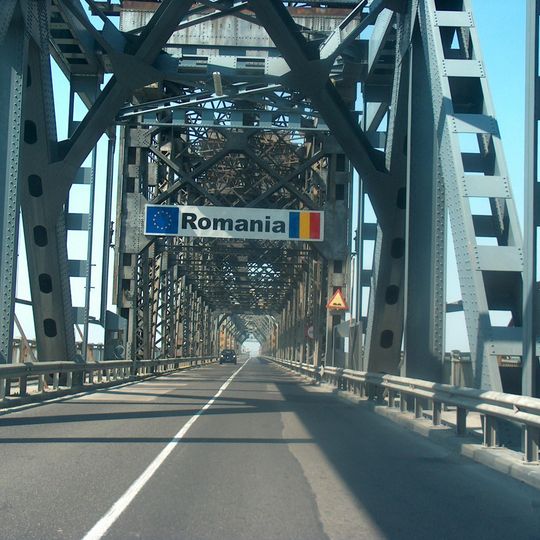
Danube Bridge, International road-rail bridge in Ruse, Bulgaria.
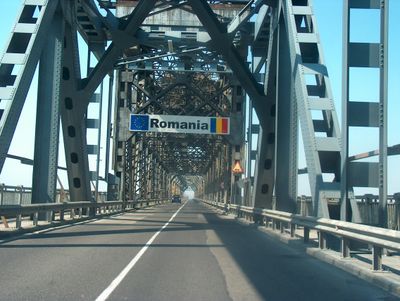
The Danube Bridge, known in Bulgarian as Dunav most, is a steel truss bridge over the Danube at river kilometre 488.7, linking Ruse and Giurgiu. It has two levels: a lower deck for trains and an upper deck for road vehicles, with a total length of 2.2 km and a height of 30 m above the water. The central 85 m section can be raised to let large ships pass.
The bridge opened on 20 June 1954, after two and a half years of construction by Bulgaria and Romania with Soviet support. The project, code-named "889", was approved by the Bulgarian Communist Party Politburo on 11 March 1950 and built by the Soviet Ministry of Transport. Earlier proposals dated back to 1881 and included Svishtov–Zimnicea and Corabia–Ghighen. The Romanian side carried out access and rehabilitation works in 2015–2016.
The bridge was opened as the Bridge of Friendship, and Bulgarians also call it Dunav most. Its artistic decoration — the portals on both banks and the eagle heads along the span — was made by Ukrainian sculptor Mykhailo Parashchuk, while the architecture is credited to Georgi Ovcharov.
Travelers can use the crossing by car, train, or on foot, with separate areas for each type of traffic. Border controls are located at both ends, so visitors should have identity documents ready and expect possible waiting times.
The artistic decoration of the bridge—the portals on the Bulgarian and Romanian banks and the eagle heads along its length—was created by Ukrainian sculptor Mykhailo Parashchuk, not by architect Georgi Ovcharov, who designed the bridge's architecture.
The community of curious travelers
AroundUs brings together thousands of curated places, local tips, and hidden gems, enriched daily by 94,282 contributors worldwide.