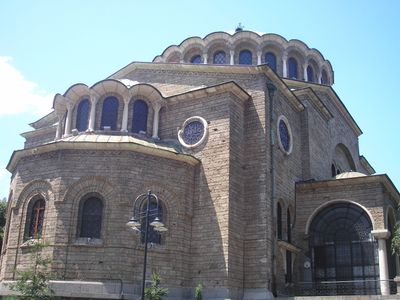
St Nedelya Church, Eastern Orthodox cathedral in Sredets District, Sofia, Bulgaria.
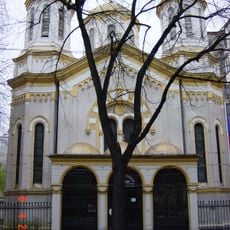
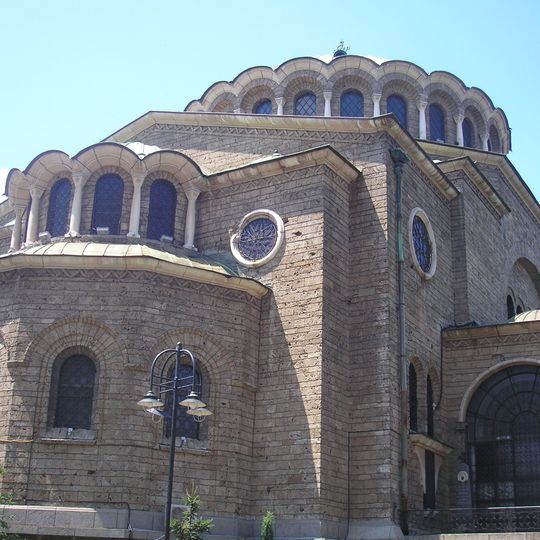
St Nedelya Church is an Eastern Orthodox cathedral in central Sofia, built between 1927 and 1933 by architects Ivan Vasilyov and Dimitar Tsolov after the 1925 bomb attack. The cross-domed building is 30 m long, 15.5 m wide and 31 m high with its central dome, its walls clad in brick. The gilt iconostasis that survived the attack was returned inside.
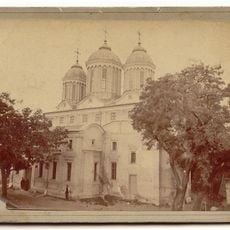
A church probably built in the 10th century with stone foundations and wooden walls stood here until 1856, when it was demolished for a larger cathedral. That 35.5-metre basilica, finished in 1863 and consecrated in 1867, was rebuilt after the 1925 bomb attack by architects Vasilyov and Tsolov between 1927 and 1933.
The name Sveta Nedelya can mean "Holy Sunday" or refer to the martyr Saint Kyriaki, called Nedelya in Bulgarian. A German traveller, Stephan Gerlach, noted in 1578 that the church was also known as Gospodnya Tsurkva and Kyriaki. In the late 19th and early 20th century it was called Sveti Kral (Holy King) because it held the relics of Serbian king Stefan Uroš II Milutin, which remain there today.
The cathedral stands on Sveta Nedelya Square, where the streets around it were raised in level at the end of the 19th century, so the church now sits on a reinforced terrace reached by wide staircases on the north, west and south sides. The main entrance is on the west, under the bell tower that holds eleven bells, eight of them given by Prince Dondukov-Korsakov in 1879. The graves of Exarch Joseph I and Metropolitan Parthenius lie against the south and north walls.
The cathedral's gilded iconostasis survived a devastating incident in 1925 that damaged the structure. Despite subsequent restoration work, this religious artwork remained remarkably intact through the years.
The community of curious travelers
AroundUs brings together thousands of curated places, local tips, and hidden gems, enriched daily by 93,467 contributors worldwide.