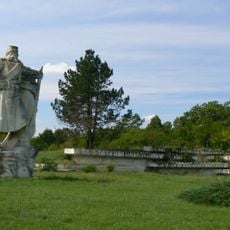
Storgosia, Roman fortress and archaeological site in Kaylaka Park, Pleven, Bulgaria.
Storgosia is a late Roman and early Byzantine fortress in Kaylaka Park, Pleven. At the start of the 4th century, 31,000 square metres were enclosed by a wall 2.20 metres wide, built of broken stone and white mortar. Excavations found two gates, three towers, a public granary and a basilica measuring 45.20 by 22.20 metres.
Storgosia began as a Roman road station on the site of today's central Pleven, possibly over an older Thracian settlement, and housed a garrison of Legio I Italica from Novae. After Gothic raids began in 238, its population moved south to the naturally defended Tuchenitsa gorge in today's Kaylaka Park. In the early 4th century a 31,000 m² area was enclosed by a wall 2.20 m wide with two gates and three towers. The fortress lasted until the end of the 6th century, when Slavic settlement ended the ancient town; under Ottoman rule its stones were probably reused in the 16th century for a wall around the Turkish barracks in Pleven.
The name Storgosia survives today as that of a Pleven neighbourhood. The site lies in Kaylaka Park, where the medieval church, houses and necropolis built over the 4th-century basilica show later reuse of the ruins.
Access to the site is via the main parking area of Kaylaka Park, from which visitors must walk to reach the ruins. The area can be explored during daylight hours, though the paths are uneven and sturdy footwear is advisable.
The fortress was largely dismantled under Ottoman rule, probably in the 16th century, when its stone was reused to build a wall around the Turkish barracks in Pleven. A second church from the 4th–5th century was found at the foot of Kaylaka hill, separate from the large basilica inside the walls.
The community of curious travelers
AroundUs brings together thousands of curated places, local tips, and hidden gems, enriched daily by 93,753 contributors worldwide.