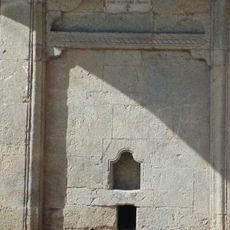
Zhaba Mogila, Thracian burial site near Strelcha, Bulgaria.
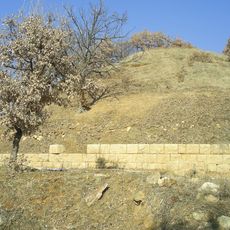
Zhaba Mogila is a Thracian burial mound near Strelcha, over 20 m high and 80–90 m in diameter. Its facade preserves six rows of stone blocks with modelled ornaments, and the entrance leads to a rectangular first chamber with a stepped 'false dome' ceiling and a second domed chamber 4.60 m across.
Dated to the 5th–4th century BCE, the mound was probably the burial place of a Thracian king of the Odrysian tribe. In 1976 the Strelcha town council funded excavations led by Georgi Kitov's EPOS expedition, which found a four-wheeled chariot, two harnessed horse skeletons and over 50 silver appliqués. The tomb had been robbed in antiquity through the eastern half of its façade.
The mound's name comes from a marshy pool nearby where frogs live, as the local population calls it Zhaba Mogila. On the summit stood a small building, likely a sanctuary, indicated by fragments of ram figures; pottery fragments suggest it also housed the priests. A stone slab with a worn lion image was found at the mound's northwest edge.
The mound lies by Strelcha in Pazardzhik Province; the site is reached on foot from the town, and the surrounding area holds many other Thracian mounds. The tomb itself was robbed in antiquity and its chambers are not set up for visitors, so the mound and its 3 m stone berm are best seen from outside. Sturdy shoes help on the uneven slope.
The name refers to a marshy puddle beside the mound where frogs lived, not to the water-filled ditch around it. Excavations in 1976 found a large clay vessel turned upside down and a horse skeleton during a probe in the southeastern part of the mound.
The community of curious travelers
AroundUs brings together thousands of curated places, local tips, and hidden gems, enriched daily by 93,648 contributors worldwide.