Thracian Tomb near Starosel, Archaeological tomb in Starosel, Bulgaria
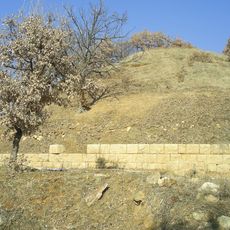
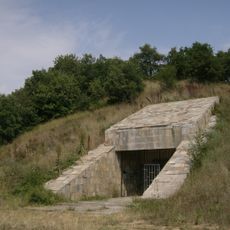
The Thracian Tomb near Starosel, known as Horizon, is a temple-mausoleum built into the Chetinova Mound. Its facade has ten early Doric columns: six across the front and two on each side, each on a base with two drums and a capital. Three steps and a central entrance lead through a wide vestibule to a smaller antechamber and the central burial chamber.
The mound was heaped and a central chamber built inside it before the mid fourth century BC; the ten-column early Doric colonnade was added later, turning the tomb into a temple. The burial, probably of a Thracian ruler or aristocrat, was looted in antiquity, leaving only 15 gold appliqués, 12 bronze arrowheads and silver beads. Radiocarbon dating of a hearth in the neighbouring Chetinova Mound, used for sacrifices to Hestia, gave 342–341 BC.
The mound is named after the European foundation Stitching Horizon, which funded the TEMP excavations led by Dr. Georgi Kitov in 2002. The site belongs to the Thracian cult centre around Starosel, where a chapel dedicated to Sveti Spas was later built over the temple foundations of the neighbouring mound, and a monastery complex stood nearby until its destruction in the 1940s.
The monument lies at the foot of Chetinova Mound, part of the Starosel cult centre in the Sredna Gora range. A wooden canopy protects the structure and already shows structural changes, so access is limited to the exterior. The colonnade of six front and two side columns is visible from the front.
The colonnade has ten early Doric columns: six across the front and two on each side, each set on a base with two drums and a capital. Visitors enter between the central columns up three steps into a wide porch, then through a smaller vestibule to the central chamber.
The community of curious travelers
AroundUs brings together thousands of curated places, local tips, and hidden gems, enriched daily by 94,038 contributors worldwide.