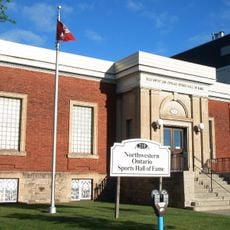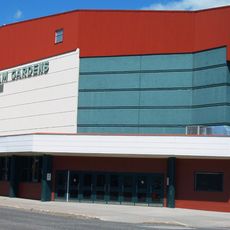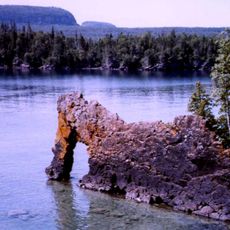
Thunder Bay Tourist Pagoda, Information kiosk and national historic site in Thunder Bay, Canada
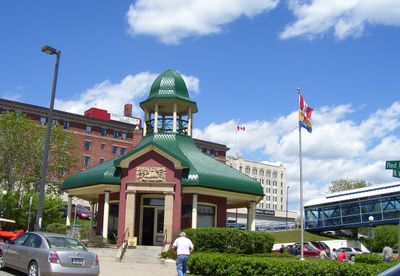
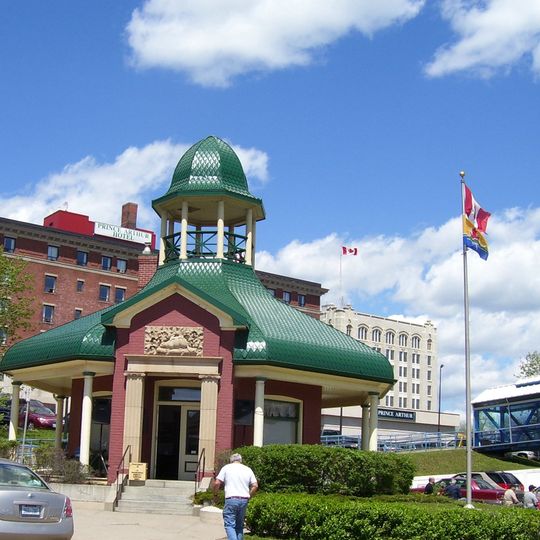
The Thunder Bay Tourist Pagoda is a hexagonal structure designed by architect H. Russell Halton, standing at 164 Arthur Street in the Port Arthur neighbourhood. A veranda surrounds the building, and its pagoda-shaped roof is topped by a cupola. A gable over the entrance carries a stone panel carved with a beaver and a maple branch.
Built in 1909 by Port Arthur city officials, this structure was designed to serve travelers arriving by transcontinental railroads and passenger ships at nearby docks. The design emerged from a competition won by local architect H. Russell Halton.
The pagoda's name comes from its roof, shaped like a pagoda and topped by a cupola. A stone panel over the entrance shows a beaver and a maple branch, symbols of Canada, while a small dragon's head on the entrance gable is described as a Scandinavian good luck symbol.
The pagoda stands at 164 Arthur Street in the Port Arthur area of Thunder Bay, on the waterfront near the former train station. It was designated a heritage property by the city in 1979, and in 1992 the Ontario Heritage Trust placed a protective easement on the building. It is no longer a working tourist bureau, having closed in 1986 and later reopened as a heritage site.
The roof was painted in multi-coloured polka dots in 1961, 1973 and 1985, a treatment no source explains. Above the entrance gable sits a small dragon's head, described as a Scandinavian good luck symbol. The stone panel over the door shows a beaver and a maple branch.
The community of curious travelers
AroundUs brings together thousands of curated places, local tips, and hidden gems, enriched daily by 93,361 contributors worldwide.