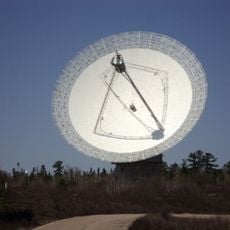
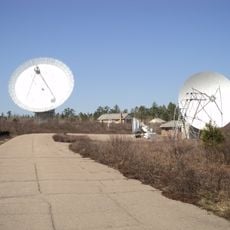
Algonquin 46m radio telescope, Radio telescope in Algonquin Provincial Park, Canada.
The Algonquin 46m radio telescope is a large parabolic antenna located in an observatory within Algonquin Provincial Park. The installation consists of a concrete foundation and rotating steel structure that allows the instrument to scan the sky in different directions.
The telescope was completed in 1966 by Canada's National Research Council as part of the Algonquin Radio Observatory complex. It played a role in early experiments that demonstrated international collaboration in radio astronomy.
The 1967 VLBI test linked the Algonquin dish with the 26-metre telescope at Penticton, British Columbia, simulating a single 3,074 km-wide instrument. Signals were recorded on 2-inch Quadruplex videotape with an atomic clock, then shipped to Algonquin and aligned on May 21. The target was quasar 3C 273, whose size was measured at under 100 light years across.
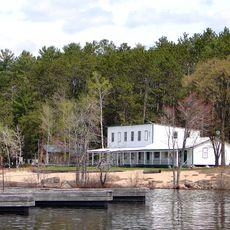
The antenna stands at the Algonquin Radio Observatory in Ontario, reachable by road; the surrounding grounds are open on foot. The dish is visible from outside, and the site is best visited in the warmer months, as winters bring heavy snow and cold. The 46 m dish is the main structure to look for.
The 1967 VLBI test linked this dish with the 26 m telescope at Penticton, British Columbia, 3,074 km away, using 2-inch Quadruplex videotape and an atomic clock to compare signals later. The target was quasar 3C 273; after a month of aligning tapes, the team succeeded on 21 May 1967 and measured it as under 100 light years across.
The community of curious travelers
AroundUs brings together thousands of curated places, local tips, and hidden gems, enriched daily by 93,043 contributors worldwide.