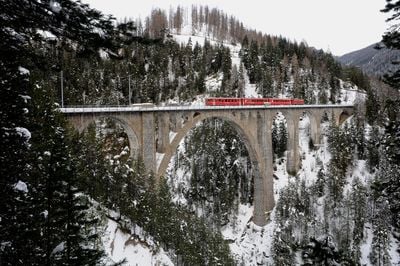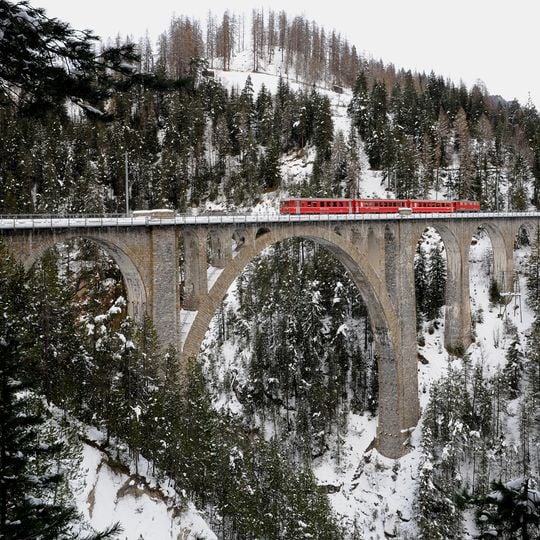
Wiesen Viaduct, Stone arch railway bridge in Grisons, Switzerland.
The Wiesen Viaduct is a stone railway bridge spanning 204 meters and rising 88 meters above the Landwasser river valley. Its seven arches support the single-track line in a visibly solid and engineered manner.
Designed by RhB chief engineer Henning Friedrich, the viaduct was built from October 1906 by contractor G. Marasi under Hans Studer's direction. Its wooden falsework, built by carpenter Richard Coray with 12 carpenters, used about 600 m³ of timber and was finished on 1 July 1908. The viaduct opened with the Davos–Filisur line on 1 July 1909 and cost 324,000 Swiss francs.
The viaduct's name comes from the hamlet of Wiesen, and its image entered art when Ernst Ludwig Kirchner painted "Brücke bei Wiesen" in 1926, inspired by the structure. The Davos–Filisur line it carries is still worked by the Rhaetian Railway, and a pedestrian bridge on its south side lets hikers walk toward Filisur.
The viaduct carries the Davos–Filisur line, so it is seen from outside: a separate pedestrian bridge on its south side links Wiesen to Filisur, and the trail from Wiesen station, 300 metres away, reaches the structure. At the western end stands a disused Hippsche turning wheel.
During construction, roughly 500 cubic meters of wood was used for the temporary framework, showing the enormous material needs for such projects. These temporary structures were themselves feats of engineering.
The community of curious travelers
AroundUs brings together thousands of curated places, local tips, and hidden gems, enriched daily by 93,849 contributors worldwide.