Gottlieben Castle, Medieval castle in Gottlieben, Switzerland.
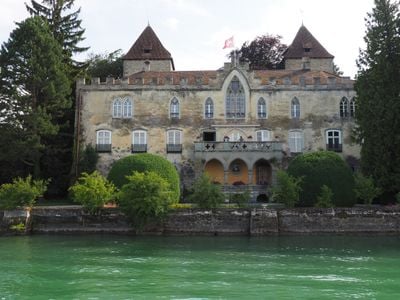
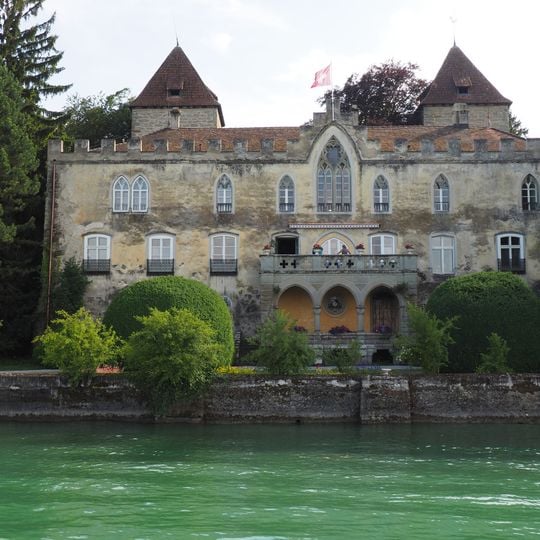
Gottlieben Castle is a former water castle on the Seerhein, built from 1251 for the Bishop of Constance. Its central section is flanked by two square towers with steep pyramidal roofs; a white flag with a red cross flies between them. The facade has many arched windows, a large pointed-arch window above a balustraded balcony, and three arched openings below, the middle one holding a small circular window. A low stone wall runs at the water's edge.
Construction began in 1251 under Eberhard II of Waldburg-Thann as a residence for the Prince-Bishops of Constance. Following the Swabian War in 1499, it took on administrative and judicial functions for several surrounding regions.
The village name appears around the end of the 10th century as Gotiliubon, and the castle's name derives from it. From 1499 to 1798 the episcopal chief constable held the low court for Gottlieben, Engwilen, Siegershausen and Tägerwilen at the castle. The white flag with a red cross on the roof recalls the canton of Thurgau.
The castle is privately owned and not open to the public, so visits are limited to the exterior. It stands at the eastern edge of Gottlieben on the Seerhein, and the facade with its two towers and the low wall at the water's edge can be seen from the embankment and the bridge area. The attic of the west tower holds the inaccessible Hus dungeon.
During the Council of Constance, the west tower's prison held reformer Jan Hus, Jerome of Prague and the deposed pope John XXIII, who had originally convened the council and invited Hus. The Hussenkerker cell in the tower's attic is not accessible. The castle is privately owned and closed to the public.
The community of curious travelers
AroundUs brings together thousands of curated places, local tips, and hidden gems, enriched daily by 94,027 contributors worldwide.