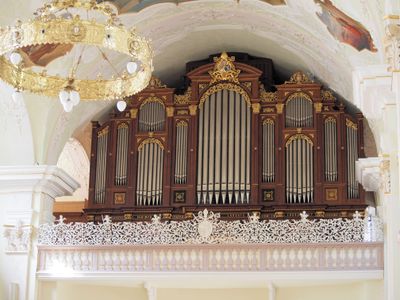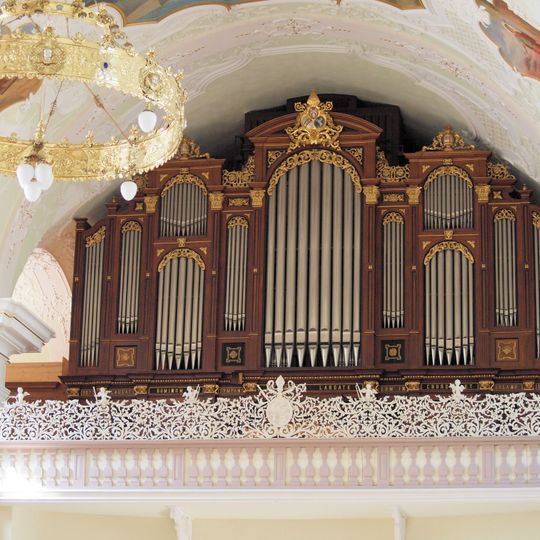
Organo del monastero di Engelberg, Pipe organ at Benedictine monastery, Engelberg, Switzerland.
The main organ of Engelberg Monastery, built by Friedrich Goll as his opus 12 in 1876/1877, stands in the Stiftskirche of the Benedictine abbey. It has 137 registers on four manuals and pedal, with 9,097 pipes; the largest pipe measures 9.06 metres, the smallest 5 mm. All divisions except the Hauptwerk and Grosspedal are enclosed in swell boxes, and the actions are electric.
Friedrich Goll built the organ as his opus 12 in 1876/1877 with 50 stops on three manuals and pedal, using cone chests with Barker levers and a swell division. From 1924 to 1926 Orgelbau Goll & Cie enlarged it to 134 stops, installed a new console and tube-pneumatic action; the contract had provided for 121 stops, and a Principal 8' was added later for tonal reasons. Orgelbau Graf AG restored it in 1992–1993, adding a new console with a setter system and two pedal stops, bringing it to 137 stops.
The organ's 137 registers and 9,097 pipes include the 9.06-metre largest pipe and a 5 mm smallest one. Its staggered swell boxes, with some divisions double or triple enclosed, allow orchestral, stepless dynamics. Six swell pedals control the pneumatic couplers, and registers 50, 51 and 52 are built as through-striking reeds.
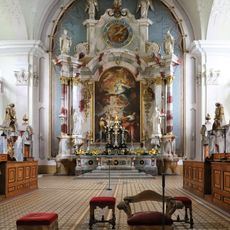
The main organ stands in the Stiftskirche of the Benedictine monastery; the church also holds a smaller choir organ from 2007 with 26 stops. The console has an electronic setter with 256 combinations and a sequencer. Six swell pedals control the pneumatic couplers, and all works except the Hauptwerk and Grosspedal can be enclosed.
The smallest pipe measures just 5 mm, while the largest reaches 9.06 m; together the 137 stops use 9,097 pipes. Stops 50, 51 and 52 are built as through-striking reeds, and six swell pedals control the pneumatic couplers.
The community of curious travelers
AroundUs brings together thousands of curated places, local tips, and hidden gems, enriched daily by 92,717 contributors worldwide.