Ming Xiaoling, Imperial mausoleum on Purple Mountain, Nanjing, China
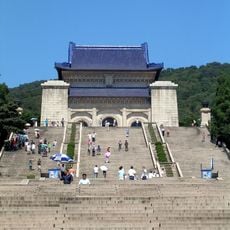
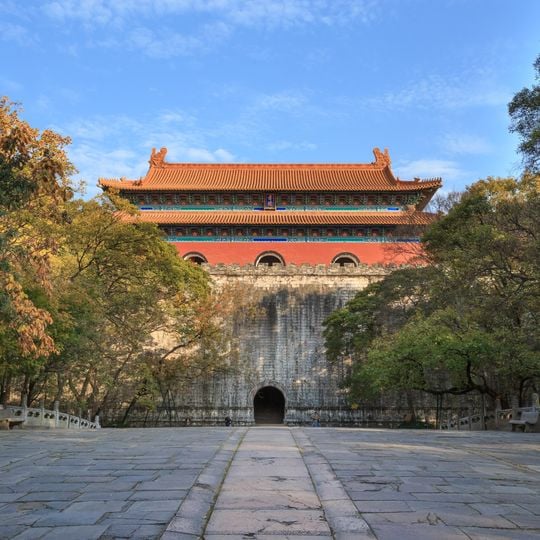
Ming Xiaoling is an imperial mausoleum at Purple Mountain in Nanjing, stretching across a large area lined with stone statues of lions, camels, elephants, and horses that guard the processional path. The cemetery is carefully laid out and moves through ordered structures toward the main burial areas.
Construction began in 1381, the 14th year of the Hongwu reign, and the main hall was finished in 1383; the complex was completed in 1405 under the Yongle Emperor, employing 100,000 labourers over 25 years. The original red wall measured 45 li (about 22.5 km), and 5,000 troops of the Xiaoling Guard were stationed to protect it. The tomb was inscribed on the UNESCO World Heritage List in 2003.
The name Xiaoling comes from the posthumous title Xiaoci of Empress Ma, buried here in 1382. Along the 2,400-metre sacred way stand 12 pairs of stone animals — lions, xiezhi, camels, elephants, qilin and horses — followed by two pairs each of military and civil officials. The route bends around Plum Flower Mountain because Sun Quan's tomb already occupied the straight line.
The visit involves walking the 2,400-metre Sacred Way from the Dismounting Archway to the Wenwu Fang Men gate, then continuing through the central axis to the Ming Tower and Baocheng. The route is not a loop, so plan your return to the entrance. The stone-paved sections are uneven in places.
To hide the emperor's actual burial location, multiple funeral processions were sent out simultaneously from different city gates. This deception strategy was designed to confuse grave robbers and protect the secret of the burial for generations.
The community of curious travelers
AroundUs brings together thousands of curated places, local tips, and hidden gems, enriched daily by 94,261 contributors worldwide.