Great Wall of Qi, Ancient defensive wall in Shandong, China
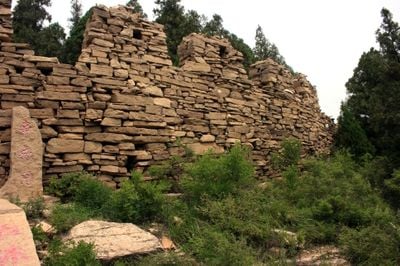
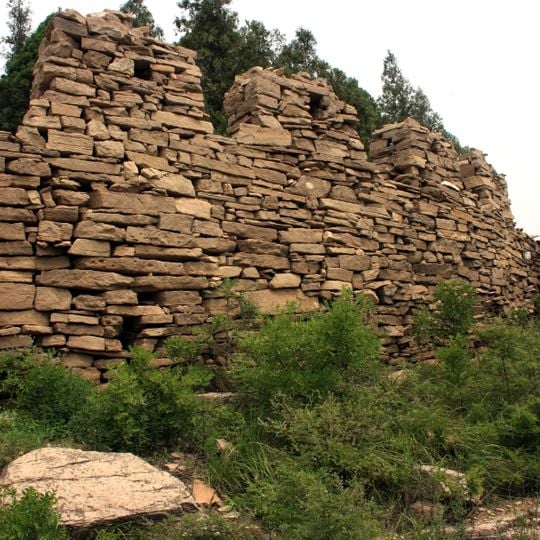
The Great Wall of Qi is a stone and earth rampart running about 600 km across central Shandong, from Guangli village in Changqing District, Jinan, to the Yellow Sea in Qingdao. It consists of a main line and three branch lines. In places it survives as tiered walls of roughly cut tan and brown stone blocks, with taller upright sections and a small rectangular opening near the top of the tallest part.
Construction of the Great Wall of Qi began during the Spring and Autumn Period and was completed during the Warring States Period, spanning 170 years of work. This early defensive structure was built hundreds of years before other well-known walls in China were constructed.
The wall's name in Chinese, 齐长城 (Qí Chángchéng), links it to the state of Qi, which built it as a military defence system in the Eastern Zhou period. Local sections were raised from stacked, roughly cut stone blocks in tan and brown, with taller upright parts at intervals; visitors can still see these courses and the uneven, broken top edge.
The wall runs about 600 km from Guangli village in Changqing District, Jinan, across the ridges of central Shandong to the Yellow Sea in Qingdao. It crosses Jinan, Tai'an, Zibo, Weifang and Qingdao among other areas, so pick a section near your route. Paths follow mountain ridges; wear sturdy shoes.
The 2024 excavation at Guangli village in Changqing district uncovered wall sections built during the Western Zhou dynasty (1046–771 BC), older than the 441 BC date recorded on the Tsinghua bamboo strips. The Xinian strips themselves were recovered from a Chu tomb and acquired by Tsinghua University in 2008.
The community of curious travelers
AroundUs brings together thousands of curated places, local tips, and hidden gems, enriched daily by 92,765 contributors worldwide.