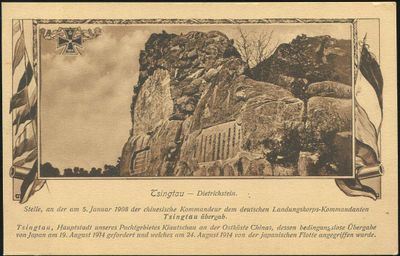
Diederichs's stone, German monument on Signal Hill in Qingdao, China.
Diederichs's stone was a monument on the southwestern slope of Signal Hill in Qingdao, built of granite blocks on the rock. The main stele measured about 5 metres high and 8 metres wide, with the whole structure 8.5 metres tall and 22 metres wide. Its face carried the German imperial eagle and a German inscription in double curved lines, with further German and Chinese inscriptions carved below.
Admiral Otto von Diederichs established this monument in 1898 to mark Germany's claim to the Kiautschou Bay concession. Japanese authorities later added their own inscription in 1914, physically layering their presence over the earlier German symbol.
The monument displayed inscriptions in multiple languages, including German text and Chinese characters that marked territorial changes in early 20th century Qingdao. These markings show how different rulers left their imprint on the same place.
The monument no longer exists: only the original site on the southwestern slope of Signal Hill (Xinhaoshan) remains, where fragments were rediscovered on 16 March 2008. Look for the edge of the German inscription and the letter "S" on the rock, and check the grass below the former base for carved pieces. The site is reached on foot within Signal Hill Park.
The monument features an unusual layering of history with the Japanese inscription placed directly across the German imperial eagle, leaving both symbols visible on the same surface. This physical overwriting documents power shifts in the region in a rare and tangible way.
The community of curious travelers
AroundUs brings together thousands of curated places, local tips, and hidden gems, enriched daily by 92,783 contributors worldwide.