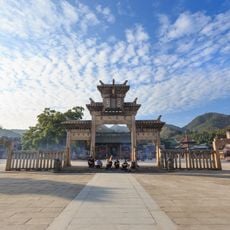
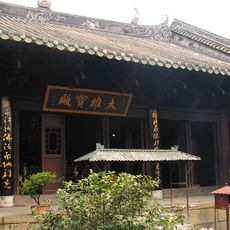
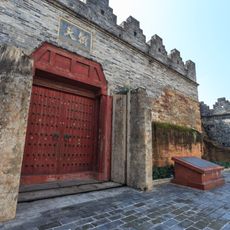
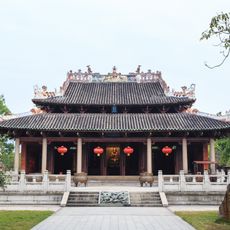
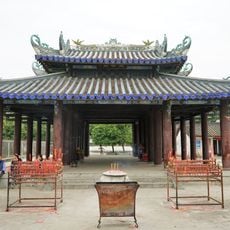
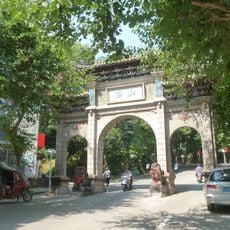
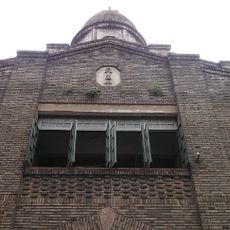
Zhenwu Pavilion, Taoist temple in Rong County, China.
Zhenwu Pavilion is a Taoist temple in Rong County featuring a wooden structure with three stories and a traditional gable and hip roof design. The building rises approximately 20 meters high and covers about 168 square meters of ground space.
The Jinglüetai platform was built between 758 and 779 by the Tang poet Yuan Jie, then jinglüeshi of Rong County, to drill soldiers. In 1377 a Taoist temple, the Xuanwu Palace, was raised on the surviving platform to ward off fire. In 1573 local officials rebuilt it as the three-storey wooden Zhenwu Pavilion. It was listed as a Major National Historical and Cultural Site in 1982.
The pavilion serves as a center where people come to perform Taoist rituals and observe religious traditions passed down through generations. Its design reflects how traditional Chinese builders understood harmony between structure and spiritual purpose.
The site is protected at the national level and provides visitors with well-developed facilities and services. Take time to view the wooden structure and roof details from different angles to appreciate the architectural craftsmanship.
Four inner columns on the second floor carry the upper storey but hang about 2 cm above the floorboards, held by lever-like bracket sets. The timber frame has survived earthquakes and typhoons for over 400 years without a single nail or iron fitting.
The community of curious travelers
AroundUs brings together thousands of curated places, local tips, and hidden gems, enriched daily by 93,398 contributors worldwide.