City Walls of Zhaoqing, Song dynasty city walls in Duanzhou, Zhaoqing, China
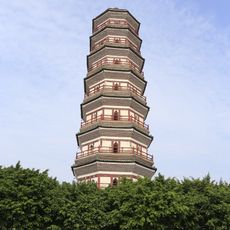
The City Walls of Zhaoqing form a roughly rectangular brick enclosure around the old city centre, wider east–west than north–south, with a perimeter of 2,801 metres. The four gates were named Songchong (east), Zhennan (west), Duanxi (south) and Chaotian (north); 28 watchtowers stand along the wall, and the Piyun Tower rises on the north-west section.
The walls date from the Song dynasty: in 1053 the prefect Jiang Jianzhi built an inner citadel, and in 1113 Zheng Dunyi enlarged it as a brick wall with four gates. Ming repairs began in 1368 under Huang Deming, and in 1614 Zhang Jingxin raised the wall by 3.5 chi. In 1924-1926 the gate towers were demolished and most of the wall lowered by about 2.3 m.
The walls display different building styles that show how Chinese construction techniques evolved over centuries. Visitors can see the craftsmanship of earlier generations reflected in the stonework and gates.
The wall top is walkable along restored stretches, notably the northwest section from People's Middle Road to the West Gate, rebuilt between 2006 and 2007 with a paved walkway of imitation grey bricks. The full circuit measures 2,801 metres, with the north section the longest at 1,028.6 metres. Piyun Tower stands on the northwest stretch.
The walls were nearly demolished in 1923, but the municipal bureau kept them because they served as flood defence; in 1915 flood damage had already required repairs funded by Li Yaohan. The gates were later filled in and ramps built.
The community of curious travelers
AroundUs brings together thousands of curated places, local tips, and hidden gems, enriched daily by 93,511 contributors worldwide.