Iron Lion of Cangzhou, Iron statue in Cang County, Hebei, China
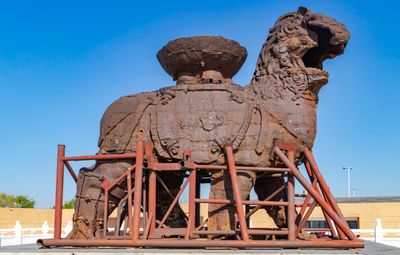
The Iron Lion of Cangzhou is a large cast iron statue in Cang County, Hebei Province, China, standing on the grounds of a former Buddhist temple. The lion is shown with an open mouth and is one of the largest surviving cast iron objects from Chinese history.
Cast in 953 during the Later Zhou, the lion's purpose remains debated: some sources say it was made to guard the city, others to suppress the sea, and its lotus throne suggests it stood in a Buddhist temple. By 1803 a storm had toppled it; it was re-erected in 1886. Since 1957, five restorations have taken place, four of which worsened its condition.
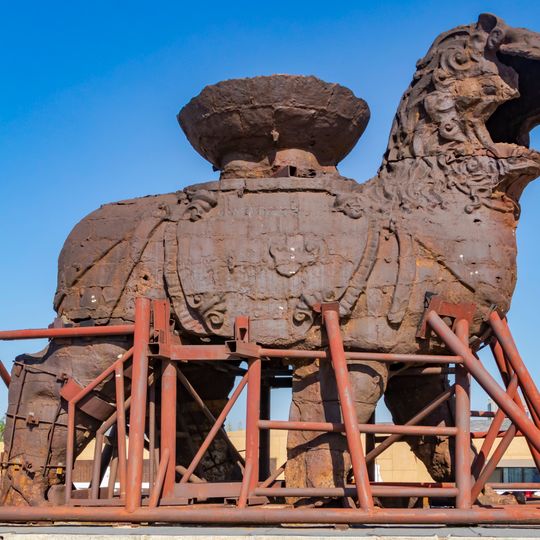
On the lion's back sits a lotus throne basin that once supported a bronze figure of the Bodhisattva Manjushri. This detail shows how closely religious devotion and craftsmanship were linked in the world that produced this statue.
The statue stands in an open-air site that can be walked around freely, allowing views from all sides. Visiting in the morning tends to give better light and fewer crowds.
The seams on the body are not joints between separate pieces: the lion was cast in a single mould, and the lines are impressions of the outer clay mould sections, each 35 to 45 cm wide and 20 to 25 cm high, about 500 in all. Wrought-iron pegs bridging the successive pours can still be traced on the surface.
The community of curious travelers
AroundUs brings together thousands of curated places, local tips, and hidden gems, enriched daily by 93,907 contributors worldwide.