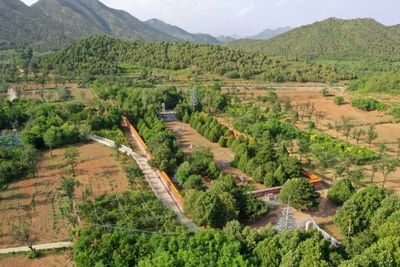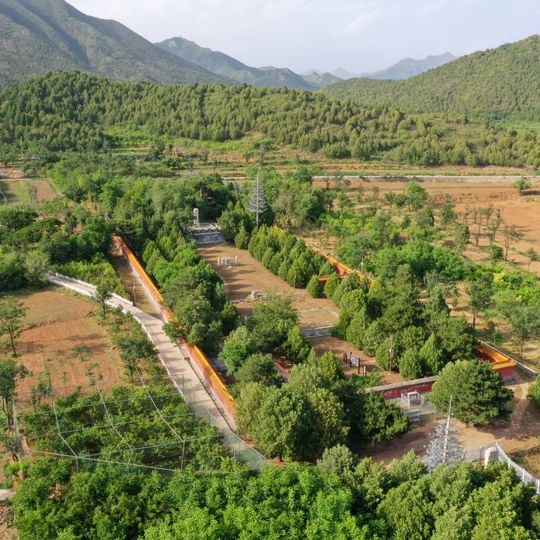
Siling Mausoleum, Ming dynasty imperial tomb in Shisanling, China.
The Siling Mausoleum is an imperial burial site from the Ming dynasty located within the Shisanling necropolis in northern China. The structure sits at the base of Tianshou Mountain and forms part of a group of thirteen emperor tombs arranged across the valley.
Siling was not built by an emperor: it began as the tomb of Consort Tian, who died in 1642 and was buried in 1644. After Li Zicheng took Beijing, Chongzhen and Empress Zhou were interred in her vault. The Qing raised the site to an imperial mausoleum, completing it in 1645; repairs followed in 1745 and 1785.
The tomb is called Siling, though Ming loyalists rejected the name and called it Cuangong, a term of humiliation. The stele in the stele pavilion was changed in 1659 from the temple name Huaizong to the posthumous name Zhuanglie Min Huangdi. The eunuch Wang Chengen, who hanged himself beside the emperor, is buried just south of the tomb; three Qing steles stand at his grave, the first inscribed with the Shunzhi emperor's eulogy of 1645.
Siling lies in the southwest corner of the Ming Tombs area, at the foot of Luma Mountain, about one li south of Xishankou. The grounds are compact: three palace gates stand 11 paces from the stele pavilion, the offering hall 13 paces from the gates, and the stone offering table 10 paces from the Ming tower. The tomb of eunuch Wang Chengen, with three Qing stelae, is nearby.
Siling is the only Ming imperial tomb whose occupant was first buried in a concubine's grave. The emperor and Empress Zhou were placed in the tomb of Consort Tian in 1644, and the Qing later elevated it into an imperial mausoleum. The stone five-piece offering set was originally laid on the ground, unlike other Ming tombs.
The community of curious travelers
AroundUs brings together thousands of curated places, local tips, and hidden gems, enriched daily by 93,816 contributors worldwide.