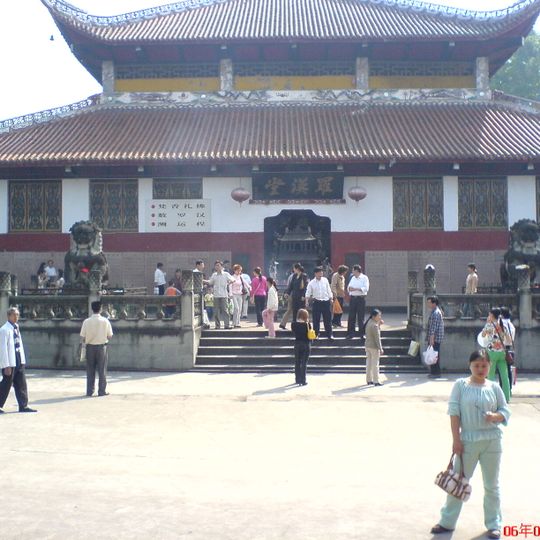
Shuanggui Temple, Buddhist temple in Liangping District, China.
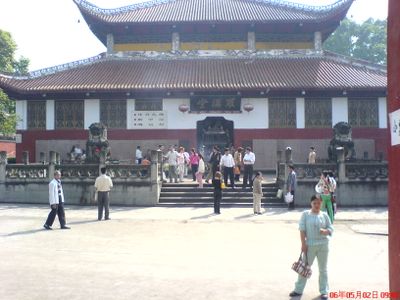
Shuanggui Temple faces west and follows a central axis of seven buildings: the Shanmen, Maitreya Hall, Mahavira Hall, Ordination Hall, Poshan Pagoda, Dabei Hall and Buddhist Texts Library. The Mahavira Hall, first built in 1653, measures 25 metres wide, 19 metres deep and 10 metres high, with 72 stone pillars supporting its roof. More than 300 side rooms and corridors connect the halls, and the brick-and-timber buildings are framed by the White Lotus Pond and a rear pond.
The temple was founded in 1653 by Chan master Poshan Haiming during the Shunzhi Emperor's reign. It received national protection status from the State Council in 2013, recognizing its importance as a historical site.
The temple's name comes from two osmanthus trees (shuang gui) on the grounds. The Five Hundred Arhats Hall, built in 1998, holds 500 life-like figures with varied faces and postures. The temple also keeps a set of the Buddhist canon bestowed by the Yongzheng Emperor, along with four objects: a deaf figure, a mute figure, a gong and a drum.
The temple lies in Jindai Town, Liangping District, and its seven main halls stand along a west-facing axis, with over 300 side rooms linked by corridors. The Mahavira Hall alone measures 25 m wide, 19 m deep and 10 m high, so allow time to walk the whole compound. The Five Hundred Arhats Hall, added in 1998, is the farthest hall on the axis.
The Mahavira Hall, first built in 1653, is 25 metres wide, 19 metres deep and 10 metres high, its roof carried by 72 stone pillars. It was renovated in 1758, 1822 and 1889. Inside stand Sakyamuni, Ananda and Kassapa Buddha, with the Eighteen Arhats, Manjushri and Samantabhadra along the sides.
The community of curious travelers
AroundUs brings together thousands of curated places, local tips, and hidden gems, enriched daily by 93,821 contributors worldwide.