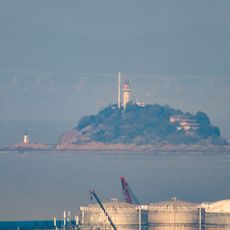
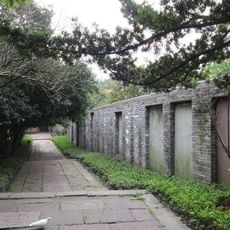
Zhaobaoshan Bridge, Bridge in Ningbo, China
Zhaobaoshan Bridge is a single-tower cable-stayed bridge of a hybrid system, 2,482 m long with a 258 m main span, linking Zhenhai and Beilun districts. From Zhenhai it passes through the 169 m Zhaobaoshan road tunnel, then crosses the Yong River to Qijiashan Street in Beilun. Its two cable planes are asymmetrical, with the north side slightly larger.
Construction began on 8 June 1995 under the name Ningbo Bridge. In September 1998, before its planned opening, the girder of block 16 cracked and the deck began to sway, an incident covered by People's Daily and CCTV's Focus Interview; design flaws including an overly thin bottom slab were blamed. After repairs, the bridge opened on 8 June 2001 and was renamed Zhaobaoshan Bridge. Tolls were abolished on 1 March 2010.
The bridge's name comes from Zhaobaoshan, the hill it tunnels through on the Zhenhai side; it was originally called Ningbo Bridge and renamed when it opened on 8 June 2001. Tolls were charged from opening until 1 March 2010, when they were scrapped under traffic pressure after the Changhong tunnel went free and congestion grew.
The bridge carries traffic between Zhenhai and Beilun, with the main road posted at 60 km/h and ramps at 40 km/h. The Zhenhai approach passes through the 169 m Zhaobaoshan Tunnel, whose two bores come within 2.98 m of each other. Tolls on the bridge and the Yongjiang Tunnel were abolished on 1 March 2010.
The Zhaobaoshan Tunnel is a twin-bore road tunnel only 169 metres long, and at its narrowest the two bores are just 2.98 metres apart. The bridge's two cable planes are asymmetrical, with the north side slightly larger than the south.
The community of curious travelers
AroundUs brings together thousands of curated places, local tips, and hidden gems, enriched daily by 94,611 contributors worldwide.