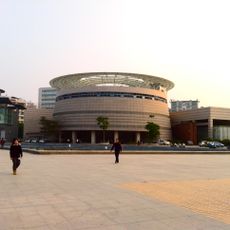
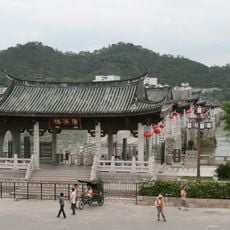
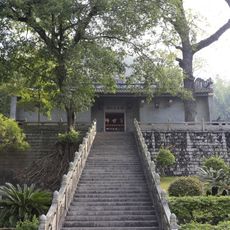
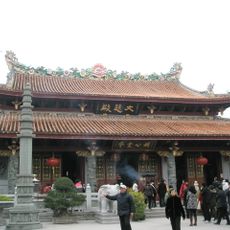
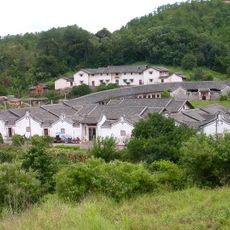
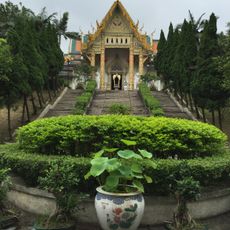
Wenguang Pagoda, Pagoda in Shantou, China.
Wenguang Pagoda is a multi-story structure built in traditional Chinese style that rises above Shantou's skyline. The building features detailed stonework and tiered levels that represent characteristic architectural design from the southern China region.
Wenguang Pagoda was first built in 1131, during the Shaoxing era of the Song dynasty, but later collapsed. In 1266 the Taoist Zhang Ruchi rebuilt it and placed a thousand Buddha statues inside, giving it the name Qianfo Pagoda; it collapsed again. In 1635 it was rebuilt and Wu Shixun renamed it Wenguang Pagoda to signify cultural prosperity. Tang Wenzao, Chaoyang magistrate, restored it in 1815; authorities repaired it in 1956, 1981, 1996 and 2009–2010.
The name Wenguang, given in 1635 by local scholar Wu Shixun, means "prosperity of culture and education". The gate plaque reads "Wenguang Pagoda", dated Jiaqing yihai (1815) and signed by magistrate Tang Wenzao, who wrote the couplet flanking it: "A thousand years of literary brush shakes metal and stone; a hundred zhang of light pierces the Dipper and Ox."
The pagoda stands on Wenguang Street in Chaoyang District, Shantou, and faces south. Inside, a spiral stone stairway of 122 steps links the seven storeys, with four doors opening onto an outer gallery on floors two to six. A 2009–2010 restoration lowered the base level by about 50 cm and uncovered a 700-year-old passage and well beneath the gate.
The 2009–2010 restoration lowered the pagoda's base by about 50 cm to restore its original height, and workers unexpectedly found an old tunnel under the gate leading to a well more than 700 years old. The stone plaque above the door reads "Wenguang Pagoda", dated Jiaqing yihai (1815) and signed by Tang Wenzao of Yuzhang.
The community of curious travelers
AroundUs brings together thousands of curated places, local tips, and hidden gems, enriched daily by 93,837 contributors worldwide.