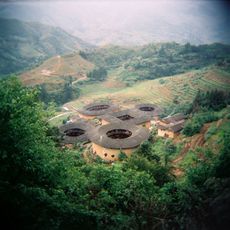
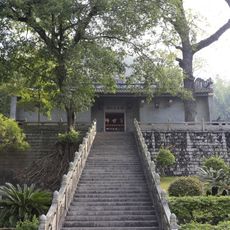
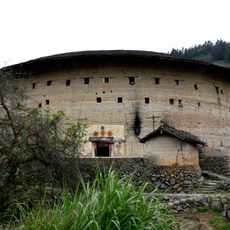
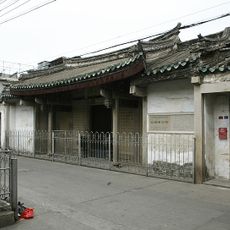
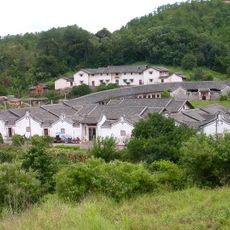
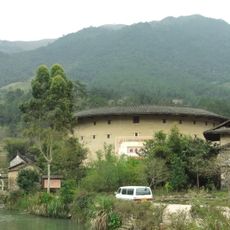
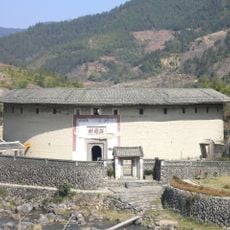
Daoyunlou, Tulou heritage building in Raoping County, China.
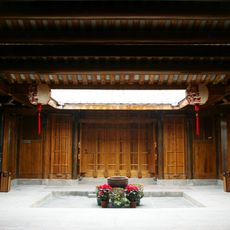
Daoyunlou, also called Bagualou, is China's largest octagonal Hakka walled village, in Nanlian Village, Sanrao Town, northern Raoping County, Guangdong. It faces north, with an inscribed-circle diameter of 101.2 m, a perimeter of 328 m, walls 11.5 m high and 1.6 m thick, and about 10,000 sq m of floor area. Inside are 56 main rooms and 16 corner rooms, a 1,000 sq m central courtyard, and 32 wells.
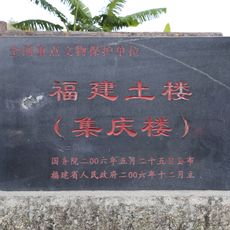
Construction of Daoyunlou began in 1477, the 13th year of the Ming Chenghua reign, and was completed in 1587, the 15th year of the Wanli reign, after three generations of the Huang family worked on it for over 110 years. The stone plaque above the main gate bears the name Daoyunlou, written in 1647 by Huang Jin, Minister of Rites of the Ming. In 2006 it was listed as a Major Historical and Cultural Site Protected at the National Level.
Daoyunlou shows how Hakka families lived together under one roof with shared spaces and private rooms. The layout reveals the daily rhythms of communal life and how residents organized themselves for mutual support and collective tasks.
The best time to visit is during drier months when the paths around the building remain in good condition. A local guide helps you understand the different areas and how each section served its purpose within the structure.
The walls were built by ramming a mixture of river sand, field mud, old wall mud and red soil with brown sugar and glutinous rice. The roof tiles were wrapped in cloth before firing, and their fabric weave is still visible. No iron nails were used: the whole frame is held by bamboo pegs that have not rotted.
The community of curious travelers
AroundUs brings together thousands of curated places, local tips, and hidden gems, enriched daily by 93,083 contributors worldwide.