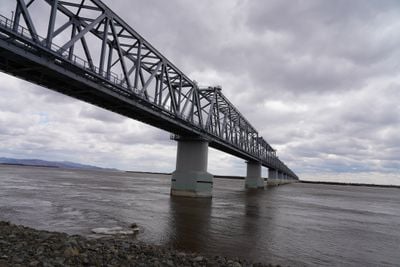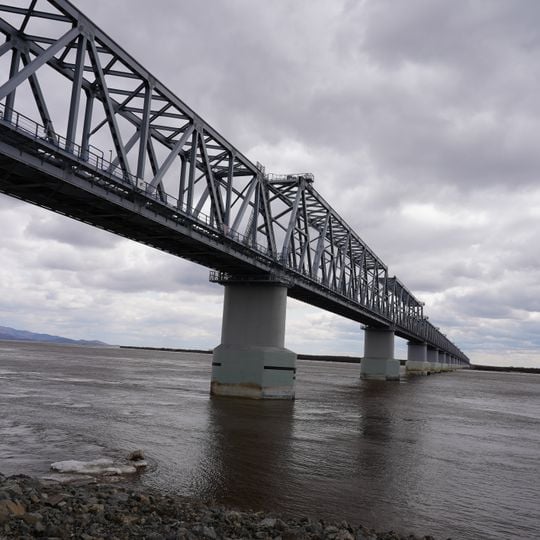
Tongjiang-Nizhneleninskoye railway bridge, Railway bridge between Tongjiang and Nizhneleninskoye, China and Russia.
The Tongjiang-Nizhneleninskoye railway bridge is a 7194-meter structure that crosses the Amur River, linking rail networks between China and Russia. The bridge is built to handle heavy freight trains crossing between the two countries on a single continuous line.
A 1995 Sino-Russian agreement first envisaged a bridge over the Amur, but the project was only proposed publicly in 2007 by Valery Gurevich, vice-chairman of the Jewish Autonomous Oblast. Construction agreements followed in 2013 and 2014, and the Chinese half was finished by July 2016 while work on the shorter Russian half began that December. The two halves were joined in 2018–2019, track laying ended in August 2021, and the first commercial train crossed on 16 November 2022.
The bridge creates a direct passage for travelers and freight between the Chinese and Russian railway systems, strengthening connections across the international border. It has become a symbol of cooperation between the two nations, visible to anyone watching trains cross the river.
This is an international rail border crossing, not a pedestrian bridge; there is no public access to the deck, and the crossing is closed to individuals. The structure is best seen from the Russian side near Nizhneleninskoye or from the Chinese bank at Tongjiang, where the steel trusses and concrete piers stand over the wide Amur channel. Check border-area rules before approaching either bank.
The bridge carries two rails of different gauges, Russian 1520 mm and Chinese 1435 mm, offset by only 800 mm, so just one track can be used at a time. Its steel truss spans over the Amur were designed by Russia's Giprostroymost institute to meet both countries' standards.
The community of curious travelers
AroundUs brings together thousands of curated places, local tips, and hidden gems, enriched daily by 94,034 contributors worldwide.