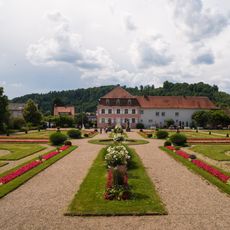
Castle Zweibrücken, Rococo castle in Zweibrücken, Germany.
Zweibrücken Castle is a Late Baroque palace built 1720–1725 by architect Jonas Erikson Sundahl for Duke Gustav Samuel, on oak piles driven into marshy ground. Its red and yellow sandstone facade faces the Schlossplatz; since 1965 it has housed the Palatine Higher Regional Court.
A 12th-century castle of the Counts of Zweibrücken preceded the palace. Duke Gustav Samuel had Jonas Erikson Sundahl build the present Late Baroque residence in 1720–1725 on oak piles. French troops sacked it in 1793; from 1818–1820 it became the Maximilianskirche, then a courthouse. Gutted in 1945, it was rebuilt from Sundahl's plans found in Nancy and reopened in 1965 as the Palatine Higher Regional Court.
The building's name recalls its origin as a ducal palace, but since 1965 it has housed the Palatine Higher Regional Court and the Zweibrücken law courts. Visitors can see the red sandstone from the northern Palatinate and yellow sandstone from Lorraine used in the 1962–1964 reconstruction. The Schlossplatz, the triangular square where the palace stands, remains a public space in the town centre.
The building is not open to visitors: since 1965 it has housed the Palatine Higher Regional Court and the Zweibrücken law courts, so the interior can only be seen from outside. The Schlossplatz on the southern side gives the clearest view of the baroque facade and the flattened roof restored in 1962–1964.
The palace stands on oak piles driven into marshy ground; the site was so soft that the builders had to stabilise it before construction in 1720. The building has been destroyed and rebuilt twice, and its 1962–1964 reconstruction used Sundahl's original plans found in Nancy.
The community of curious travelers
AroundUs brings together thousands of curated places, local tips, and hidden gems, enriched daily by 93,853 contributors worldwide.